AI Unmasked the Climate Change Hysteria
Yesterday I closed the article about TypeSafe with this paragraph:
“And if I ever manage to spend enough tokens to boil an entire lake with the datacenter’s heat, I will spend it with the greatest pleasure in the world. It’s my personal revenge against whoever forced me to use paper straws that dissolve in your mouth for all these years.”
I confess: it was deliberate provocation, written already knowing I was going to explain it here today. Because behind the joke there’s a serious thesis.
Last week I took apart here the AI fear propaganda from OpenAI, Anthropic, and NVIDIA. Today I want to use the same lens on a much older and much more profitable hysteria: the climate one. And there’s an irony in the middle: what unmasked this hysteria was AI itself, by accident.
The thesis is simple. The moment the datacenter race tightened for real, every “green” commitment from governments and big techs evaporated. The same Microsoft that promised to be carbon negative is restarting Three Mile Island. The same Germany that shut down its nuclear fleet now has a chancellor admitting it was a strategic mistake. What took down the climate agenda was another agenda, one with more money.
And before anyone labels me, my position in full: yes, there is a human effect on the climate. No, the world is not ending, and the distance between those two sentences is where the hysteria lives. What I dispute is the industrialized panic and the misallocation of trillions it justifies.
Every decade has its apocalypse
I grew up under the nuclear apocalypse of the Cold War. We lived with the certainty that the world could end in atomic mushrooms at any moment. When the USSR fell in 1989, that fear drained away, and the hole in the ozone layer filled the void. That one, by the way, is recovering decades after the 1987 Montreal Protocol, which phased out CFCs and friends: proof that a real problem with a cheap solution needs no hysteria.
Then came the Y2K bug. Then “global warming”. And when “warming” got hard to sustain in every headline, the agenda changed its name to “climate change”.
Notice the trick. Orwell called it Newspeak in “1984”: capture the words to capture the thinking. “Global warming” was a testable hypothesis: either it warmed or it didn’t. “Climate change” accommodates everything. Heat, cold, drought, flood, snow, lack of snow. Any event confirms the thesis, and a thesis that everything confirms explains nothing.
When the vocabulary is captured, the question becomes a crime. Whoever asks for evidence becomes a “denier”. A scientist funded by obscure interests becomes an “expert”, and “expert” gets sold as a monopoly on truth. The covid hysteria was the worst fruit of this way of thinking, but covid is for another article. The climate case is enough.
The human cost of this machine is measured. A 2019 Washington Post/Kaiser Family Foundation survey of American teenagers found 57% afraid and 52% angry because of the climate. A global UN poll that collected about 9.7 million votes asked about priorities: “action on climate change” came in last among 16 topics in the global total, and even in the poorest countries it sat at the bottom of the list. The people want hospitals and jobs. Whoever ranks the apocalypse first is whoever has their comfort guaranteed.
Follow the money: who funds the fear
About Greta Thunberg, one fact bothers both sides: she herself keeps none of the money. Her father told Politico she never received a cent, and she donated the entire 1-million-euro Gulbenkian prize to climate projects. The character is real and, by all accounts, unsalaried.
The girl and the startup
The machine around her is another story. The school strike started on August 20, 2018, a Monday. The Swedish startup We Don’t Have Time, founded by advertising man Ingmar Rentzhog, was still building its climate social network. On the day of the strike, Rentzhog posted the girl’s photo on his personal Facebook and the company account tweeted the same day, tagging Al Gore’s Climate Reality Project. Three days after the strike began, on Thursday, August 23, the family book, “Scenes from the Heart”, hit bookstores.
The startup’s fundraising prospectus, from November 2018, cited Greta 11 times, without the family’s knowledge; that round raised ~13 million Swedish kronor, and the company said it had raised 23 million in total by early 2019. She was a junior advisor to the company’s foundation from October 2018 to January 2019 and left. The product was the startup; the girl was the marketing.
The salaried protest industry
Then came the industrialization of protest. The Climate Emergency Fund, founded in 2019, funds Just Stop Oil, Extinction Rebellion, Scientist Rebellion, and friends. The one who opened the vault with $500,000 was Aileen Getty, heiress to the Getty oil fortune, mind you. Hollywood director Adam McKay came in with $4 million and a board seat.
By April 2022 the fund had already distributed $1.7 million to activists in 25 countries; the full-year tax filings point to ~$5 million in grants. Just Stop Oil alone received almost $1 million, helping pay the salaries of some 40 organizers. That soup on the Van Gogh canvas is salaried work, funded by oil inheritance and movie money.
Billionaire foundations and governments
Above the protest funds sit the big foundations. Bloomberg Philanthropies alone totals $1 billion in the Beyond Carbon campaign, and the New York Times called Bloomberg perhaps the biggest individual funder of climate activism in the world. The Hewlett Foundation committed $600 million over five years, Rockefeller announced in 2023 it would invest more than $1 billion in climate over five years, and ClimateWorks has already distributed more than $2 billion. That’s an industry, with the budget of a small country’s GDP.
And governments fund the pressure against their own political opponents. The EU pays €15.6 million a year in operating grants to some 30 green NGOs through the LIFE program, and in January 2025 the European Parliament held a formal debate about Commission-funded NGOs lobbying the Commission itself, in which the budget commissioner admitted it was “inappropriate” for parts of the Commission to sign agreements obliging NGOs to lobby specific MEPs. In Germany, Correctiv received €2.5 million in public money since 2016, the “Demokratie leben!” program had a budget of €182 million in 2024, and the CDU filed 551 formal questions about the political neutrality of state-funded organizations.
And who profits from the policies? Enron’s internal memo from December 1997, written from Kyoto, was already celebrating: “this agreement will be good for Enron stock!!”. The climate-industrial complex was born together with the treaty. Global revenue from carbon pricing, taxes and emission markets combined, hit a record $104 billion in 2023, and a 2008 Point Carbon study for the WWF estimated between €23 and €71 billion in windfall profits for generators in five EU countries in phase II of the European carbon market alone. And the biggest beneficiary of Western green targets has a name and an address: China controls more than 80% of every stage of the solar panel manufacturing chain and produced almost 75% of the world’s electric cars in 2025. The West subsidizes demand; Beijing sells the supply.
If you don’t know the Enron case, take a minute and watch:
Who wins
So who benefits from the fear narrative? Billionaire foundations, consultancies, subsidized industries, governments buying social peace with grants, and the West’s biggest industrial competitor. Greta walked away without a dime. The machine kept the megaphone.
The datacenter race
Some of the numbers I’m about to show come from the research I did for my talk at Tropical Ruby 2026, about energy and AI. The IEA data tells the story:
- Datacenters consumed 415 TWh in 2024, about 1.5% of the world’s electricity.
- In 2025: ~485 TWh, 17% growth in one year; AI-focused datacenters alone grew 50%.
- Central projection for 2030: ~945 TWh, the consumption of all of Japan, close to 3% of the planet.
In the US, datacenters account for almost half of all electric demand growth through 2030. And the money followed: big tech capex went from $400 billion in 2025 to ~$715 billion guided for 2026, more than the annual investment of the entire American energy sector. Cumulative datacenter investment between 2026 and 2030 is expected to hit $3.9 trillion.
And even that doesn’t cut it. The bottleneck stopped being chips and became copper and concrete:
- PJM, the largest grid operator in the US, closed for the first time in history a capacity auction below the reliability requirement, in December 2025: ~6.6 GW came up short. The capacity price jumped to $333.44 per MW-day, more than 11 times the level of the 2024/2025 auction, hitting the ceiling allowed by FERC.
- High-power transformers have a two-to-three-year waiting list, and the biggest models run past that. The American interconnection queue has more than 2,000 GW waiting, about 1.6 times the country’s entire installed capacity.
- Of the ~16 GW of large datacenters Sightline Climate forecast globally for 2026 (the American slice is ~12 GW), only ~5 GW were under construction at the start of the year, and the estimate is that 30% to 50% of that announced pipeline will slip.
The queue in the market now is for GPUs, power, and datacenters.
Remember the electric car, the green agenda’s great salvation? The entire global EV fleet consumed ~250 TWh in 2025, about 1% of the world’s electricity. Datacenters consumed almost double, already last year. And the projection tells the rest: from 415 TWh in 2024 to ~945 TWh in 2030, that’s +530 TWh of new load on the grid, almost three times the electricity of the entire 2024 global EV fleet (~180 TWh).
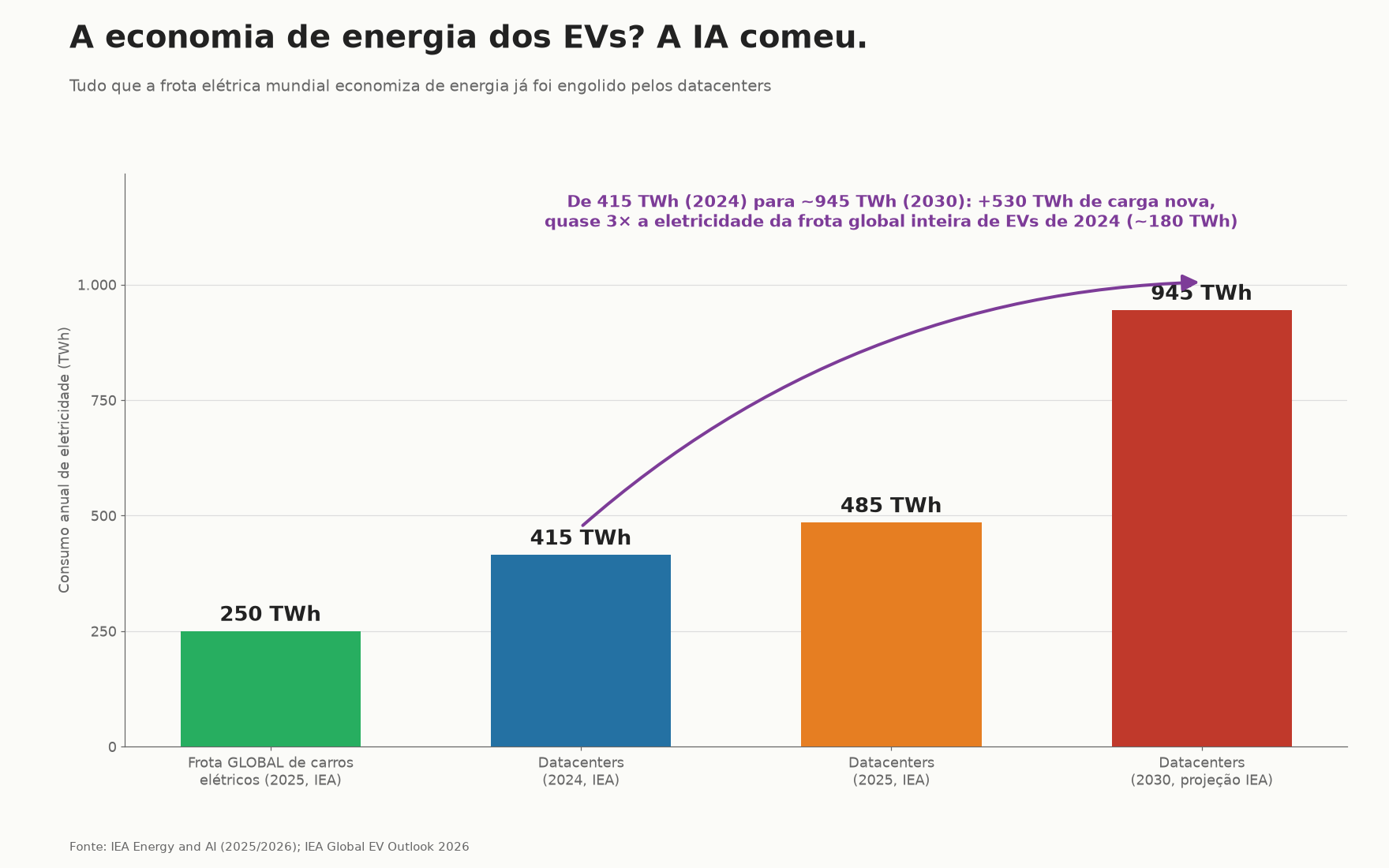
The entire decade of “green economy” was swallowed in two years of AI race. And the comic detail: in March 2026, Bernie Sanders and Alexandria Ocasio-Cortez announced the AI Data Center Moratorium Act, an attempt to ban new datacenters in the US. The green agenda spent decades telling you to consume less energy. Faced with AI, the coherent exit left over was trying to ban the new consumer.
The return of nuclear power
If the climate agenda were serious, its greatest ally was always nuclear power: the cleanest, densest, most reliable source there is. The same agenda that preached apocalypse treated nuclear as taboo for fifty years. Here’s what AI’s hunger for energy did in one year:
Big tech’s nuclear race
- Microsoft signed a 20-year contract to restart Three Mile Island’s Unit 1, 835 MW. Read that again: Three Mile Island, the ultimate symbol of American nuclear fear since 1979, resurrected as the Crane Clean Energy Center to feed datacenters.
- Meta locked in up to 6.6 GW in nuclear agreements with Vistra, TerraPower, and Oklo.
- Google ordered 500 MW in modular reactors from Kairos.
- Amazon expanded its contract with the Susquehanna plant to 1.9 GW through 2042 and invested in X-energy.
The technical reason is simple. In the US, nuclear runs at a capacity factor around 91%, and stayed above 92% on average for the decade through 2023; wind sits at ~34% and solar at ~23%. Datacenters want baseload, 24 hours a day. Sun and wind don’t deliver that without a mountain of batteries nobody has.
If you don’t know the 1979 Three Mile Island incident, watch:
The German case
And Germany? Germany shut down its last three plants on April 15, 2023 and became a net importer of electricity for the first time since 2002, including importing French nuclear. The Energiewende cost in the range of hundreds of billions of euros, German industrial electricity costs about double the American or more, and the German grid emits around 350 g of CO2 per kWh, against 22 g from nuclearized France.
Well then. In January 2026, Chancellor Friedrich Merz admitted in public: “It was a serious strategic mistake to phase out nuclear energy”, “we are now undertaking the most expensive energy transition in the entire world”. The head of the IEA itself, Fatih Birol, went public agreeing with him. Since May 2025 Germany stopped sabotaging nuclear France in the EU, and in June 2026 former bosses of the closed plants formally asked for the reactors to be reactivated.
Let me put my opinion on record here: closing the nuclear fleet was one of the biggest mistakes in Germany’s modern history. They impoverished their own industry, got hooked on Russian gas, went back to burning coal in the 2022 crisis, and today buy nuclear electricity from the neighbor. All of it in the name of an agenda they themselves are abandoning.
Fear versus the numbers
About the fear itself, the official numbers say otherwise. Deaths per TWh produced, counting accidents and pollution: coal kills 24.6; oil, 18.4; gas, 2.8. Nuclear: 0.03, less than wind and almost equal to solar. Chernobyl killed 30 workers directly, and the Chernobyl Forum and WHO projection for eventual cancers sits at up to 4,000 among the 600,000 most exposed, while Greenpeace was selling 93,000. The same report concluded the biggest public health problem was the psychological damage: people got sick from fear of radiation, not from radiation. Fukushima: zero radiation deaths among the public (Japan recognized a single radiation-linked death: a worker with lung cancer, in 2018); 2,313 deaths linked to the panicked evacuation. Fear killed more than the accident.
And the waste? All the used fuel from America’s commercial reactors fits on a football field, stacked less than 10 yards high, about 9 meters. France has been reprocessing its own at La Hague for decades. Finland built the world’s first deep geological repository for used nuclear fuel, Onkalo, already in the final stretch of licensing. A technical problem solved long ago; what was missing was political courage, and it arrived in the form of a datacenter power bill.
The man who’s been pointing this out for twenty years
The person who has organized this argument with rigor for two decades is the Dane Bjorn Lomborg. A political scientist by training, a statistics professor for years at the University of Aarhus, former visiting professor at Copenhagen Business School, fellow at Stanford’s Hoover Institution, founder of the Copenhagen Consensus Center, a think tank that works with hundreds of economists, Nobel laureates included. He blew up in 2001 with “The Skeptical Environmentalist” and became persona non grata of the green establishment, despite repeating the same sentence since forever:
“Global warming is real, but it is not the end of the world. It is a manageable problem.”
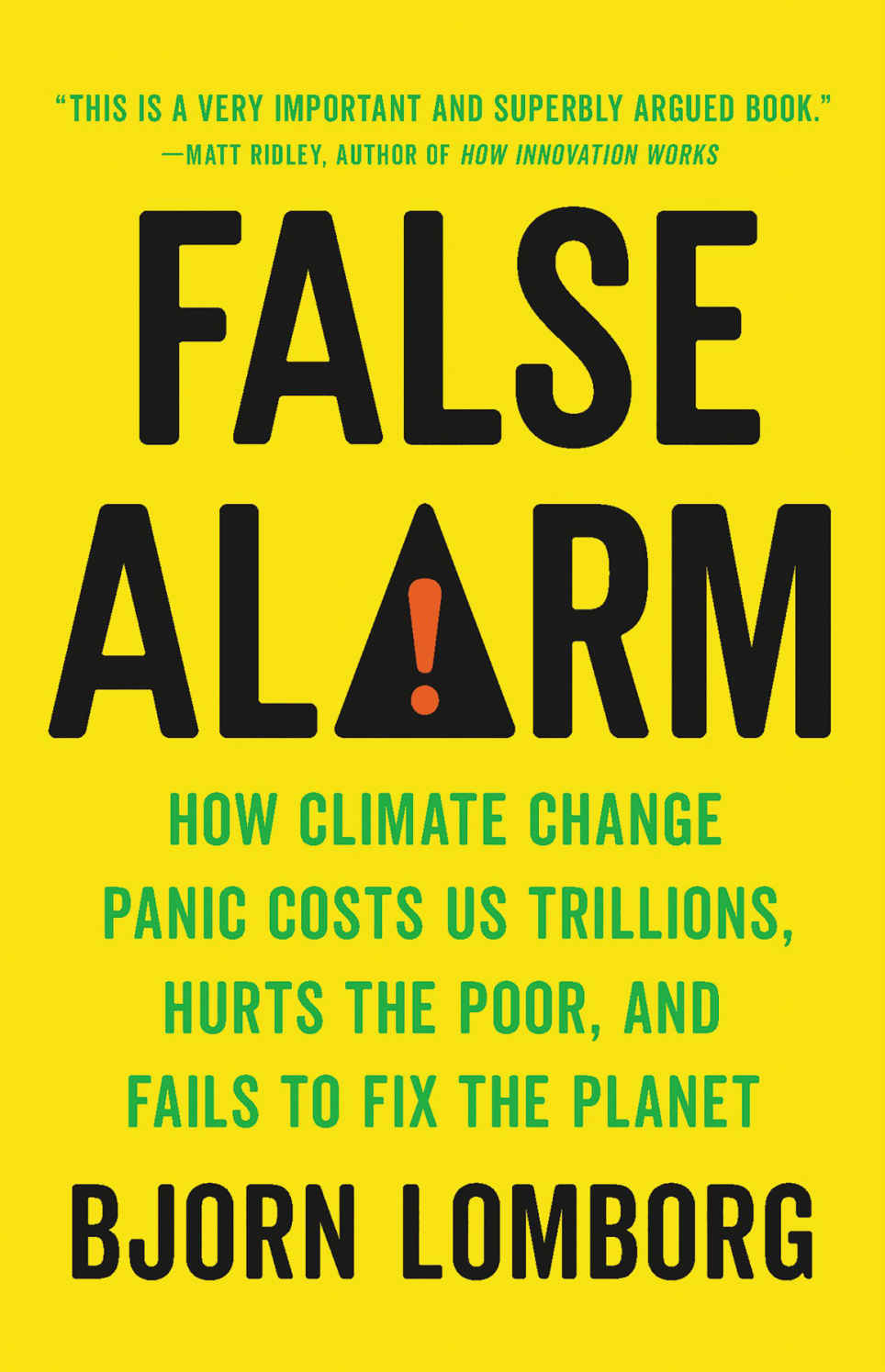
Take note: Lomborg accepts the scientific consensus on the existence of warming and its human cause. He defends a carbon tax and investment in green R&D. What he contests is the panic and the math of the policies. His 2020 book, “False Alarm”, is a catalog of numbers the headline never tells you:
The numbers the headline doesn’t tell you
- Deaths from climate disasters (drought, flood, storm, wildfire, extreme temperatures; Lomborg’s compilation over the EM-DAT database): from ~500,000 per year in the 1920s to fewer than 20,000 per year today, a 96% drop. Since the population quadrupled, individual risk fell 99%.
- In Lomborg’s synthesis of the Stanford Energy Modeling Forum models, complying with the Paris Agreement costs between $1 and 2 trillion per year, the most expensive pact in human history. And the effect of fulfilling every 2030 promise, measured in the MAGICC model, the same one used by the IPCC, is to reduce 2100 warming by 0.048°C, in his paper in Global Policy. Stretching every promise to 2100: 0.17°C. Every dollar spent on Paris avoids 11 cents of damage.
- The cost of warming with no action at all, in the damage function of Nobel laureate William Nordhaus: about 3 to 4% of global GDP in 2100. Lomborg applies this to the IPCC income scenarios and translates: instead of having 4.5 times today’s income, we’ll have 4.34 times. A manageable problem.
- New Zealand calculated that its net-zero costs between 5% and 17% of 2050 GDP, against the previous target of cutting 50% of emissions. Lomborg converts the country’s slice of emissions, by his math, into a three-week postponement of global warming.
- Tuvalu, the poster country of “it’s going to vanish into the sea”, grew 2.9% in area over four decades with the sea rising at double the global average. And the “187 million displaced by 2100” headline comes from a study for up to 2 meters of sea level rise with no adaptation; the same study, with dikes and realistic adaptation, calculates between 41,000 and 305,000 displaced.
- A study in The Lancet that analyzed 74 million deaths in 13 countries attributed 7.3% of them to cold and 0.4% to heat: in the current climate, cold kills some 17 times more.
The math nobody lets you do
Now the comparison that matters. The Copenhagen Consensus’s “Best Things First” calculated: $35 billion per year on twelve cheap solutions (treating tuberculosis, malaria bed nets, child nutrition, vaccines) would save ~4 million lives per year. Treating tuberculosis costs $6.2 billion a year and saves ~600,000 lives a year this decade, a return of ~$46 per dollar. Malaria alone killed 610,000 people in 2024, 95% in Africa, most of them children under 5. A delivered treated net costs about six dollars; saving a life with them costs around $5,500.
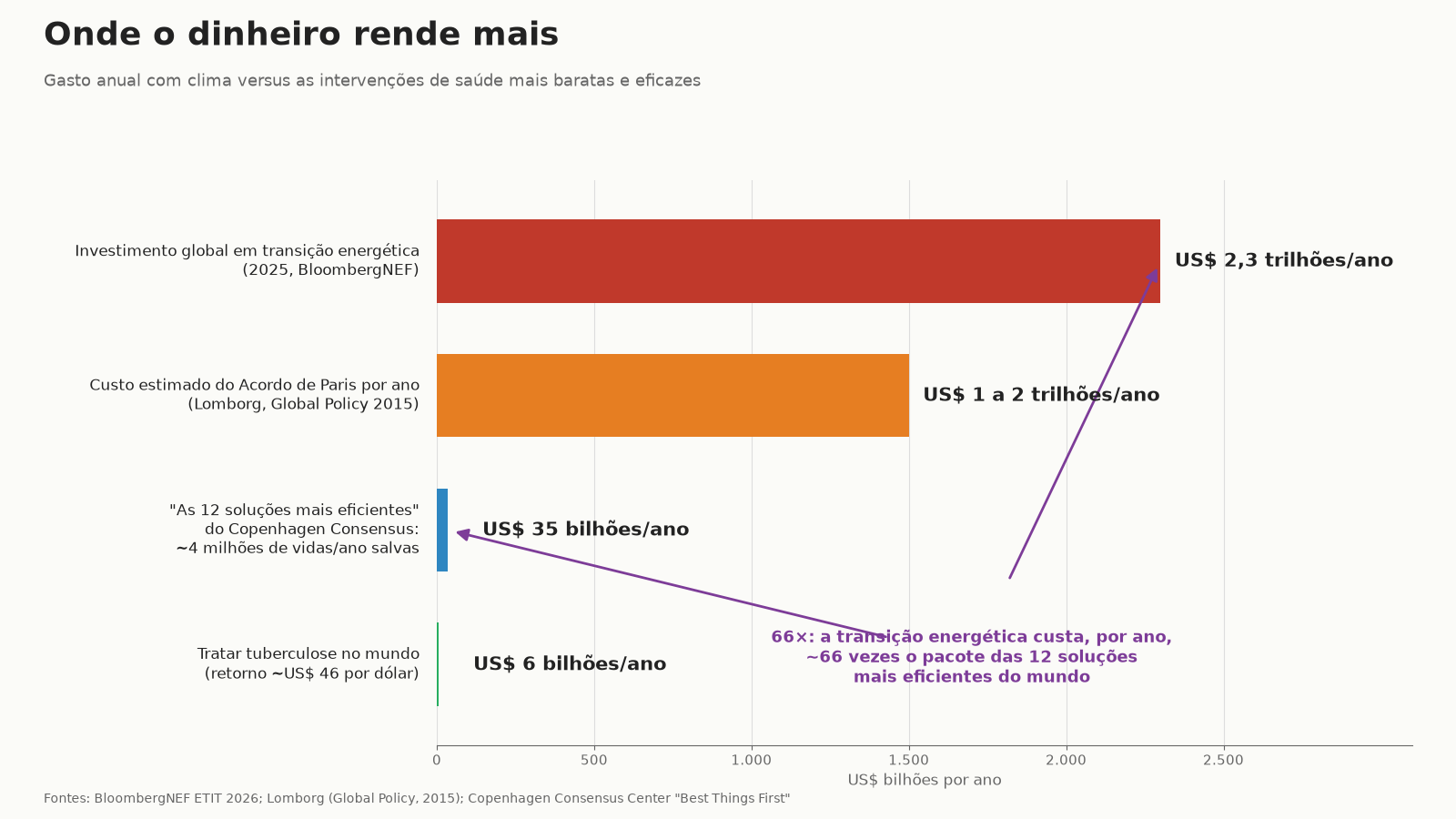
International climate aid alone, a quarter of all development aid, would be enough to fund tuberculosis, malaria, contraception, and nutrition in the entire world and still leave change. That’s the real choice on the table. Nobody lets you do this math out loud without being called a monster.
His 2005 TED talk, “Global priorities bigger than climate change”, is exactly this cost-benefit exercise, done on stage, twenty years ago. Worth the 16 minutes:
And since the comments will aim at the messenger, let me get the rap sheet out of the way early. About Lomborg you’ll hear that a Danish “scientific dishonesty” committee declared his first book objectively dishonest in 2003. True. And Denmark’s Ministry of Science overturned the decision at the end of the same year, over flaws in the process. You’ll also hear about Scientific American’s eleven-page hostile dossier. All on record. And none of it touches the numbers, which come out of the IPCC, the WHO, the FAO, and EM-DAT.
Thirty years of summits, and the score is zero
Before China, it’s worth looking at the full track record of the process that produced these policies. Three decades of treaties, each announced as historic, each with the same result:
The treaties
Rio, 1992. The UNFCCC is born, with the written goal of “stabilizing greenhouse gas concentrations in the atmosphere”. Result: global fossil CO2 went from 22.5 gigatonnes in 1992 to 37.4 in 2024, +66%. At Mauna Loa, atmospheric CO2 went from 356 ppm to 427 ppm, with no visible dent in the growth curve.
Kyoto, 1997. Target: industrialized countries would cut 5.2% below 1990 by 2012. The US Senate preemptively rejected the idea 95 to 0 before the final text even existed. Canada left the treaty in 2011 when it became clear it would miss the target. Global emissions rose 43% while it was in force. The countries that “complied” complied for free: the post-Soviet industrial collapse and the 2008 recession did the work. And Kyoto’s second period, the Doha one, covered 37 countries and ~14% of global emissions and entered into force on December 31, 2020: the last day of the period it governed.
Kyoto’s credit mechanism, the CDM, became a fraud factory: industries in China and India produced HFC-23, a greenhouse gas 14,800 times more potent than CO2, just to destroy it and sell credits, a €2.6 billion scheme. The Öko-Institut, auditing for the European Commission itself, found that 85% of projects had a low likelihood of integrity. A 2024 study in Nature Communications calculated that fewer than 16% of the carbon credits analyzed correspond to real reductions.
Copenhagen, 2009. The goal was the binding successor to Kyoto. It collapsed live: the final text was taken note of, not adopted, drafted on the last night by the US, China, India, Brazil, and South Africa. What survived was the promise of $100 billion a year for the poor world, met for the first time in 2022, two years late.
Paris, 2015. The target system is self-assigned and the targets are not legally binding. Of the 197 parties, only 58 had economy-wide targets in domestic law or policy, and only 17 with ambition equal to or greater than what was promised on paper (Grantham Institute, via Lomborg). Nature wrote in 2017 that every major industrialized country was falling short. The US left, came back, left again (effective January 2026) and, in January 2026, announced its withdrawal from the UNFCCC itself, the 1992 convention, something no country had ever done. Since Paris, emissions rose from 35.4 Gt to 37.4 Gt, every year, except for the covid dip.
Belém, 2025 (COP30). The house was ours, and the result was a portrait of the state of the process. Before it opened: delegations from Africa and the Pacific formally complaining about the lodging crisis, with stratospheric hotel rates and part of the delegations sleeping on cruise ships. During: a fire in the blue zone evacuated the delegates in the middle of the final negotiation, with 13 people treated for smoke inhalation. It was the first COP without an American delegation in 30 years, and Trump mocked the event on Truth Social, the highway through the rainforest and all. Attendance: ~42,000 in person, half of what Dubai had. And what came out of it? A text called “Global Mutirão” (mutirão is Portuguese for a collective work effort) with the fossil fuel phase-out plan ripped out after pressure from Saudi Arabia and allies, despite more than 80 countries backing it, and a promise to triple adaptation finance already born weakened, from 2030 to 2035. The bill for the Brazilian taxpayer: ~R$4.7 billion in the federal package alone (Union Budget, BNDES, and Itaipu), not counting what the state and the city spent on their own and never consolidated in public. One more circus paid for with our money, with nothing to show at the end.
The COP circus
And there’s the circus itself, which isn’t just ours. COP28 in Dubai had 83,884 in-person participants, including 2,456 fossil fuel lobbyists, which perhaps explains the final texts. Glasgow had 118 private jets; COP27, some 315 executive jet trips. And the cherry on top of our edition: Avenida Liberdade, 13 km of road cutting through Belém’s Environmental Protection Area, with 68 hectares of vegetation cleared (the project was the state’s and predates the COP, but the cut in a protected area is fact).
The scoreboard of 32 years of treaties: +68 ppm of CO2 in the atmosphere, zero deceleration. The emissions curve doesn’t know the treaties exist.
Patient zero of the hysteria: Al Gore
Before the treaty machine, the propaganda had a founding father. Al Gore lost the 2000 election and reinvented himself with “An Inconvenient Truth” (2006): an Oscar, the 2007 Nobel Peace Prize shared with the IPCC, and the template for every hysteria that came after. Practically every apocalyptic prediction you hear to this day premiered in that film.
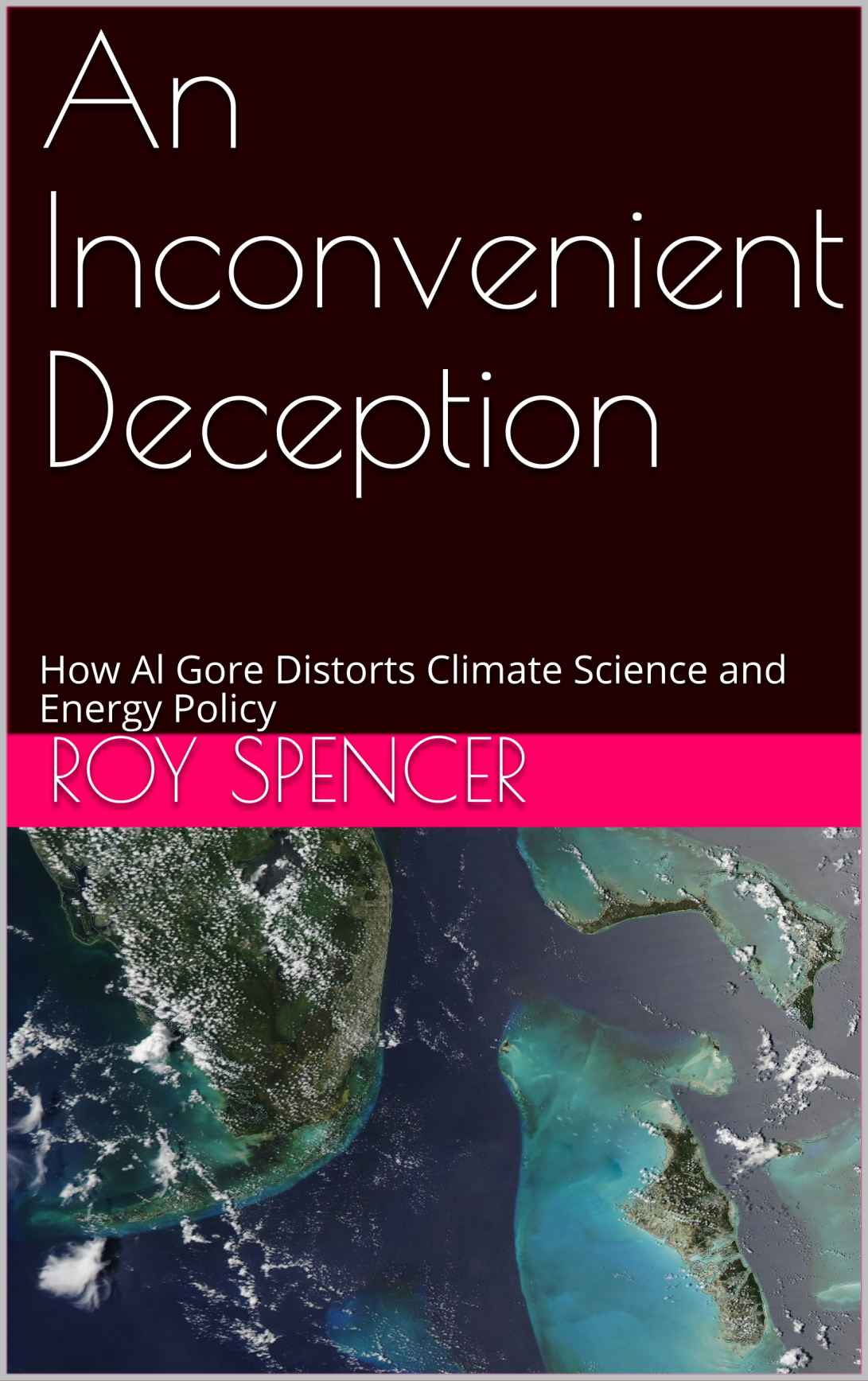
The one who dissected the film claim by claim was Roy Spencer: PhD meteorologist, former senior climate scientist at NASA, co-creator with John Christy of the UAH satellite temperature dataset, the independent reference for global temperature. His position is the “lukewarmer” one: CO2 warms a little, the theory is solid up to there; the catastrophe is the exaggeration. In 2017 he published “An Inconvenient Deception” (Kindle on Amazon), which I read for this article. Gore’s catalog of busted prophecies, with Spencer’s data:
The catalog of busted prophecies
- “Ten years to the point of no return” (2006). Ten passed, almost twenty passed. The trend measured by Spencer’s own satellite: ~0.16°C per decade, through June 2026.
- Arctic summer ice “could be gone as early as 2014”: the line is from his Copenhagen speech, December 2009, citing a modeler who later disowned the number. It didn’t vanish.
- Kilimanjaro’s snows by 2016: still there.
- Stronger and more frequent hurricanes after Katrina: what came was a drought of almost 12 years without a single major hurricane touching the US, from Wilma in October 2005 to Harvey in August 2017, the longest since 1850. NASA researchers calculated that a gap like that happens once every 270 years. And the global cyclone count has no upward trend since the 1970s.
- “Up to 20 feet of sea level rise”: the measured global rate today is ~3.4 mm per year, about 1.4 inches per decade. The Battery Park tide gauge in Manhattan measures 1.16 inches per decade since 1856, and part of that is the land sinking. At this rate, 20 feet takes more than a millennium.
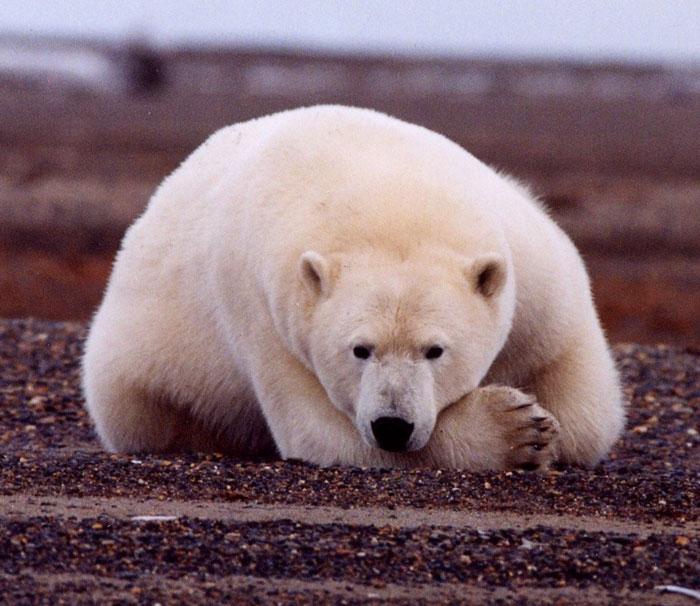
- The drowning polar bears: the film’s animated scene was born from a short note in Polar Biology about four bears found dead after a storm in 2004. The estimated global population sits between 22,000 and 31,000, probably larger than in the 1970s, when no reliable estimate even existed and the real threat was unregulated hunting, solved by the 1973 treaty. Twenty years later, “the bears are dying” still circulates as fact.
- The Syria drought, “the worst in 900 years”, said to have caused the civil war: rainfall data for the west of the country, Aleppo, Damascus, Homs, stayed above average; the strong 2007/08 drought concentrated in the northeast. What broke the countryside was the government tripling the price of diesel in 2007-2008, which made pumping well water unviable.
- The flooding of the 9/11 memorial by hurricane Sandy, presented in the sequel as “I told you so”: in the original film he talked about gradual sea level rise, never storm surge. Spencer calls it explicit deception.
- The tabletop experiment with Bill Nye, heating CO2 in glass jars in the Climate Reality Project’s “Climate 101” video (2011): Anthony Watts’s analysis showed the experiment doesn’t work and the result was faked in post-production. According to Spencer, the video stayed on Gore’s site for years afterward.
- The crops: the 42 climate models used by the UN predicted summer warming in the American Corn Belt; NOAA data shows no significant warming there since 1960.
The cast of the prophecies is going strong. The bears, too:
The character
And the character: Spencer documents that Gore got rich on “green” investments (he’s a cofounder of Generation Investment Management), keeps mansions and an industrial-sized carbon footprint. And even the establishment didn’t swallow the film whole: in 2007, the British courts found nine errors in “An Inconvenient Truth” and called the sea level part “distinctly alarmist”. Spencer’s word for Gore’s technique is “wordsmithing”: writing in a way that leads the audience to conclude what he never stated in so many words.
The audience, by the way, had already tuned out: in the first weeks of the 2017 sequel, the screening Spencer attended in a 750-seat theater had three people, and one left halfway through.
If this subject got to you, the two bedside books are Spencer’s, above, and Lomborg’s “False Alarm”, which I used in the previous section. One dissects the propaganda; the other dissects the bill.
Spencer’s rap sheet also comes ready-made in the comments: he’s one of the favorite skeptics of Republicans in Congress, the UAH dataset had famous corrections in the 90s and 2000s (published and incorporated decades ago), and a 2011 paper of his in Remote Sensing was so contested that the journal’s editor resigned, saying the article had slipped through by mistake. All real. And none of it changes the Battery Park tide gauge or the calendar of expired prophecies. Criticize the numbers, if you can. The messenger is just the messenger.
The arithmetic of insignificance
Let’s get to your electric car and your paper straw. China accounted for 32% of global fossil CO2 in 2024, more than the US, the EU, and India combined. China started construction on 94.5 GW of new coal plants in 2024 alone, a ten-year record, and burns more than half of all the planet’s coal every year since 2011.
Now your individual actions, with the numbers:
- The entire global EV fleet displaced ~1.3 million barrels of oil per day in 2024, something like 0.5% of the world’s fossil CO2. That’s the total size of the impact of the biggest green policy of the decade.
- Lomborg calculated in 2020: an average subsidy of $10,000 per EV to save ~8 tonnes of CO2, worth $48 in the RGGI, the carbon market of the American Northeast states, at the time. You paid ten grand for 48 dollars of carbon.
- Lomborg’s math, with IEA data from the time: an EV emitted ~26 tonnes of CO2 over its lifetime against ~34 for a gasoline car, a 24% cut. And it depends on the grid: the Volvo XC40 study calculated the battery payback at 146,000 km driven on the global average electric mix (84,000 km on the European mix, 47,000 km on wind power). On a coal-powered grid, it’s worse.
- Paper straws: even if every estimated straw on the coasts ended up in the sea in one year, they’d make ~0.03% of the annual plastic entering the ocean.
- Household recycling: of all the plastic that became waste in history through 2015, only 9% was recycled; 12% incinerated; 79% went to landfill or into nature (Geyer et al., Science Advances 2017). And plastic doesn’t recycle in a loop: each cycle degrades the polymer, it becomes a lower-quality product, and it postpones the landfill by one step. The worst part: NPR showed that the plastics industry knew since the 70s that recycling didn’t pay and sold the symbol anyway, so you’d keep buying guilt-free. The exception that proves the rule is aluminum: recycling uses 5% of the energy of producing from scratch, and Brazil is the world champion at it, with 97.3% of cans recycled in 2024. Recycling works when the physics and the economics close. When they don’t, it’s kitchen liturgy.
Your paper straw doesn’t show up in this math. Neither does your EV. The math is dominated by whoever builds 94 GW of coal plants per year.
These gestures are liturgy, and this is where their real damage lives. The paper straw gives that feeling of “at least I’m helping”, and that feeling numbs. The person makes the micro-sacrifice, feels part of saving the world, and closes their eyes to the actually big problems, like the children dying of malaria in Africa I showed two sections back. Objectively, the gesture moves nothing. Subjectively, it buys the conscience. It’s worse than useless.
And Lomborg’s complete thought is even more brutal: if the rich world zeroed all its emissions and stayed at zero for the rest of the century, the temperature increase in 2100 would drop 0.7°F, less than half a Celsius degree, in his math with the MAGICC model. The West’s total sacrifice is a rounding error.
The world doesn’t fit in your head
Part of the hysteria exists because most people have no sense of the planet’s physical scale. Let’s fix that real quick, in human language.
The Sun. The Earth continuously intercepts ~173,000 terawatts of solar energy. All of civilization consumes ~20 TW. The ratio is more than 8,000 to 1, and the Earth captures only one part in 2.2 billion of what the Sun emits. A single large coronal mass ejection carries billions of tonnes of plasma with energy in the range of 10^25 joules, something like fifty million Tsar bombs. In 1859, the Carrington Event set telegraphs on fire and drew auroras in the sky over Cuba. No human control panel participated.
The Moon. Tides are the Moon deforming the ocean: a bulge of water on its side, another on the opposite side. The lunar effect on the tide is ~54 cm; the Sun’s, ~25 cm. In the Bay of Fundy, the tide swings 16 meters, and each flood tide brings in ~160 billion tonnes of water, more than all the rivers in the world combined in the same period. Meanwhile, the Moon drifts away 3.8 cm per year and the Earth’s day gets longer by some 2 milliseconds per century. Some 620 million years ago, the day was almost 22 hours.
El Niño. Normally the trade winds push the Pacific’s warm water west. Every 2 to 7 years they weaken, the warm water slides east, and the global average temperature rises 0.1 to 0.2°C for a year or two, on its own, no cars, no industry. La Niña does the opposite. When you see a “hottest year in history” headline, check whether there was an El Niño: there almost always was.
New York and Lisbon. New York sits at 40.7°N. Lisbon, at 38.7°N; Madrid, at 40.4°N. Same latitude. New York buries itself in snow every winter; Lisbon and Madrid have mild winters by comparison. The explanation: the westerly winds throw moderate air across the Atlantic onto Europe, while the American east coast receives freezing continental air from the Arctic, with the Atlantic transporting ~1.2 petawatts of heat north via the meridional current of which the Gulf Stream is part. Iceland, at 64°N, has winter averages comparable to New York’s. Latitude rules far less than current and wind.
The Sahara fertilizes the Amazon. Every year, ~182 million tonnes of dust leave Africa crossing the Atlantic; ~28 million tonnes fall on the Amazon basin, carrying ~22,000 tonnes of phosphorus, almost exactly what the rain leaches from the forest’s soil each year. The world’s biggest desert feeds the world’s biggest forest, and it’s been happening for millions of years before you were born.
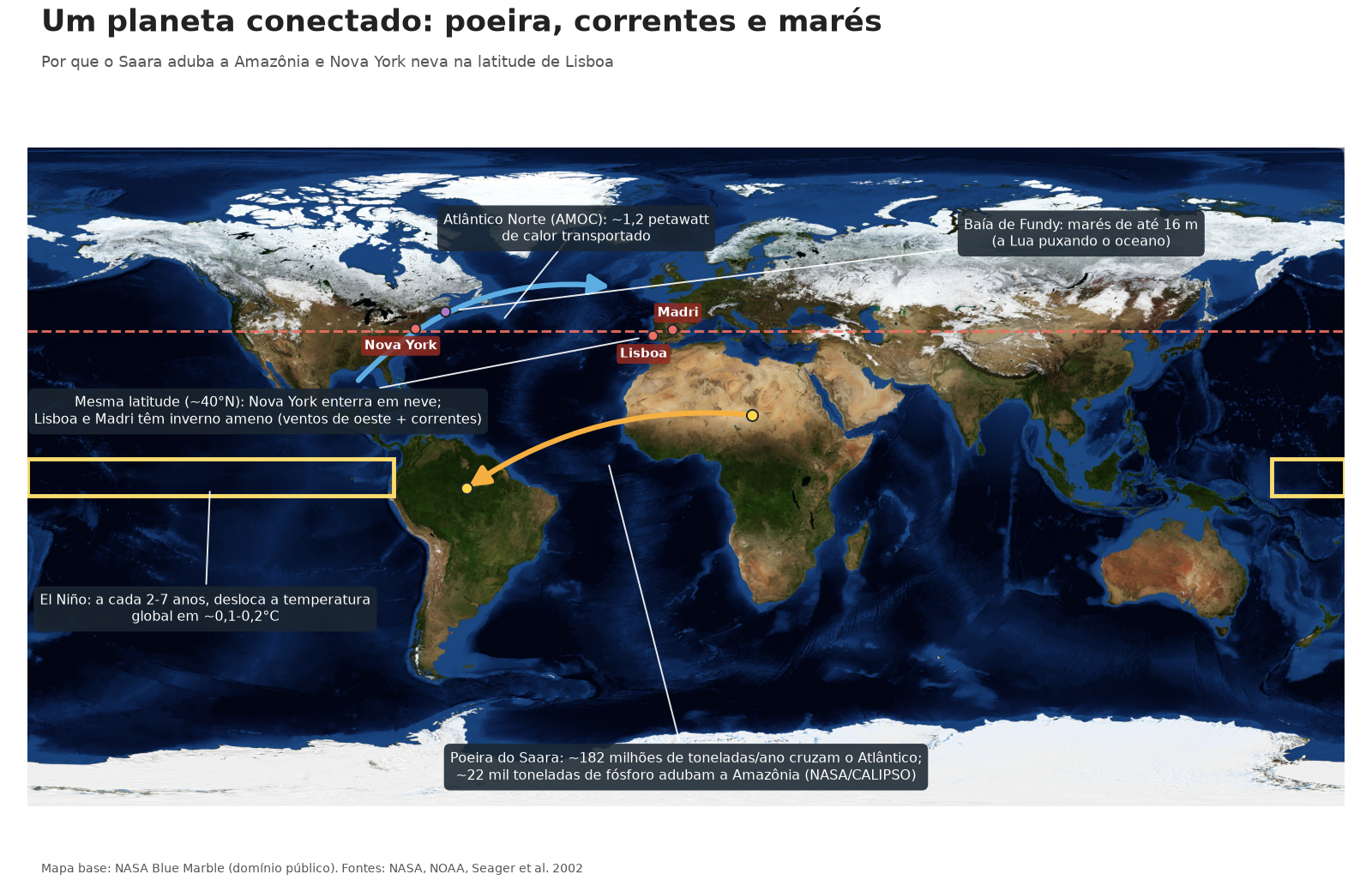
And if you zoom out the time scale, it gets even more absurd:
The Sahara was once green. Between ~11,000 and ~5,000 years ago, the Sahara was savanna with lakes, hippos, and crocodiles, and the Cave of Swimmers, in Egypt, holds rock art of people swimming in what is now desert. The driver was the orbital precession cycle, and the flip to desert took decades to a few centuries, depending on the region. And it comes back: the next orbital summer maximum arrives in some 10,000 years.
The Earth was once a snowball. Twice between ~717 and ~635 million years ago, the Sturtian and Marinoan glaciations took ice all the way to the tropics: there are glacial deposits at tropical latitudes to prove it. The Earth got out of it on its own: the global ice shut down the process that pulls CO2 out of the air, volcanoes stacked CO2 for millions of years up to hundreds of times the current level, and the greenhouse effect beat the ice.
The Mediterranean once dried up. Between 5.97 and 5.33 million years ago, the Mediterranean Sea nearly evaporated and left layers of salt more than a kilometer thick on its bed. When the Atlantic broke through at Gibraltar, the flood filled the sea back up with 90% of the volume in months to two years, at a flow estimated at a thousand times the Amazon’s.
Sharks in Kansas. In the Cretaceous, with the sea level 100 to 200 meters above today’s, a shallow sea split North America in two, from the Gulf of Mexico to the Arctic. Mosasaurs and sharks swam where Kansas is today.
The plants almost starved. At the last glacial maximum, CO2 fell to ~180 ppm, dangerously close to the ~150 ppm range where C3 plants start to fail. Glacial-era trees preserved in the La Brea tar show physiological carbon starvation. Plants evolved in a world with much more CO2, and today the planet is greening: the Zhu et al. 2016 study, publicized by NASA, measured greening across 25 to 50% of vegetated areas between 1982 and 2009, with ~70% attributed to CO2 fertilization.
CO2 became a synonym for a dangerous gas that must be fought at any cost. For plants, it’s food. When CO2 rises, green life tends to rise with it. If CO2 were poison, there would be no plants.
Rainforest in Antarctica. In 2020, Nature published the discovery of intact roots of a temperate forest that grew at 82°S, some 900 km from the South Pole, ~90 million years ago, with a mean annual temperature of 12 to 13°C. New Zealand climate, in Antarctica.
The climate has always changed
“Climate change” is an oxymoron. Changing is what the climate does, since forever, without asking permission.
For most of Earth’s history there was no permanent ice at the poles. The planet’s normal condition is greenhouse, no polar ice. In the Cambrian, CO2 was 10 to 20 times the pre-industrial level. At the peak of the Cretaceous, the global average was some 10°C above today’s, or more. Antarctica only gained permanent ice 34 million years ago.
And the great die-offs, which the hysteria loves to invoke, happened five times before any industry:
- ~444 million years ago (Ordovician): ~85% of species, glaciation.
- ~372 million (Devonian): ~75%, ocean anoxia.
- ~252 million (Permian, “the Great Dying”): ~96% of marine life, volcanism.
- ~201 million (Triassic): ~80%, volcanism.
- ~66 million (K-Pg): ~76%, the dinosaur asteroid. That one’s just the most famous.
On the more recent scale: the current ice age began 2.58 million years ago, with ice cycles every ~100,000 years in the last million of them. 20,000 years ago, hundreds of meters of ice covered where Manhattan is today, and the sea level was 120 meters lower. 11,500 years ago, at the end of the Younger Dryas, Greenland warmed ~10°C in about a decade. Then came the Medieval Warm Period, the Little Ice Age with the Thames freezing until 1814, and the “year without a summer” of 1816, courtesy of the Tambora eruption. All of it without a single coal plant.
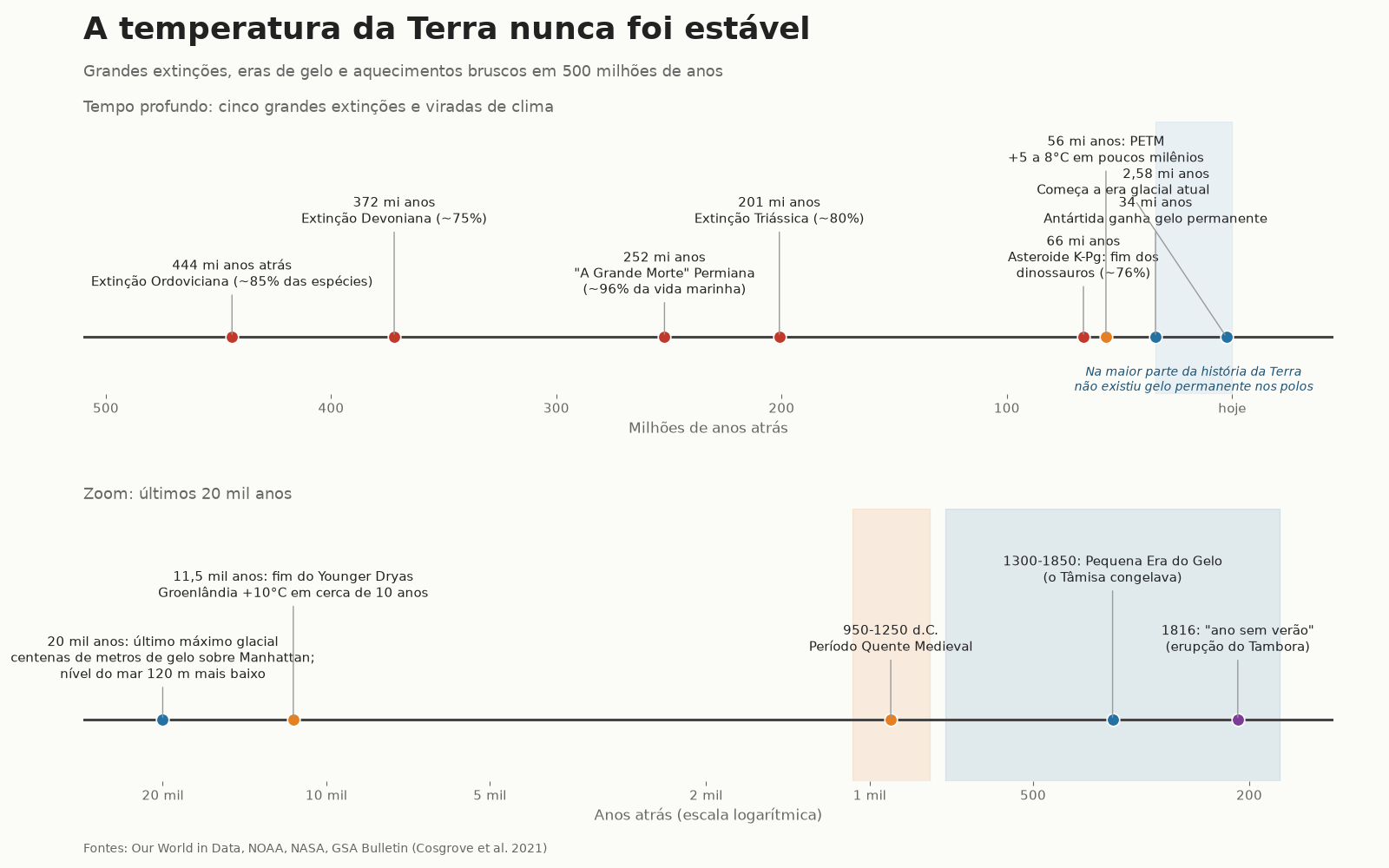
To be clear about what I’m saying: none of this proves the current warming doesn’t exist, and the current speed of the CO2 rise is indeed faster than the natural precedents. Lomborg himself says so. What this scale destroys is the phrase “end of the world”. A planet that has already been 10°C warmer with the sea 120 meters lower is not in its death throes. The serious discussion is about the cost-benefit of each policy, which is exactly the discussion the hysteria forbids.
The hysteria died of natural causes: money
Fear doesn’t save the planet, doesn’t help the environment, and doesn’t improve anyone’s life. Fear sells narrative, funds consulting, elects politicians, and stuffs foundations with money. The cost of this era is right there: trillions torched on gestures that don’t move the thermometer, while 4.9 million children died in 2024 before turning 5 from diseases the developed world forgot exist.
And then AI came along and closed the subject by accident. Notice how nobody talks about COPs in the headlines anymore. The conversation now is datacenter gigawatts, 20-year nuclear contracts, gas turbines. The same CEOs who signed climate letters are fighting over power plants. The same governments that imposed paper straws approve reactor subsidies. The climate agenda left the stage without being refuted, evicted by a bigger agenda.
If the end of the world were really on their agenda, you wouldn’t be watching Three Mile Island being restarted to train chatbots. You’re watching it. It was theater, and the theater closed when a more profitable show opened in the room next door.
Fear doesn’t save the planet. Fear sells. And whoever bought the fear is now buying megawatts.