
Update note: this post went up on 9/9 and was updated through the week as the soap opera kept going: the letter from 25 Fields medalists (9/11), Dario Amodei’s essay and the response from Altman and Musk (9/12), Trump’s remarks (9/13), fact-check fixes raised in the comments, and Pirate Wires’ report on the PR firm behind Coxon (9/25).
This week was a festival of aggressive advertising from the AI companies. There were so many pompous declarations in so little time that you could use it as a case study in deceptive marketing. So let me repeat my usual motto, because it never fails:
“Your excitement about AI is inversely proportional to your knowledge about AI”
If you read this week’s headlines and walked away excited that the Terminator is coming, or that the machine just became God, you fell for the advertising. And I’m going to take it apart piece by piece so you understand why.
And let me put my cards on the table right away, because I’ve been saying this for a while on the podcasts I show up on. To me, Dario Amodei, from Anthropic, has a God complex. The guy truly believes he is saving humanity, with that creepy woke messianism of his. And Sam Altman, from OpenAI, is a mobster. He fancies himself Michael Corleone, the cold, calculating boss from The Godfather, but in practice he’s Fredo: the weak, bumbling brother who thinks he’s the smart one and keeps screwing up. Keep these two portraits in mind, because everything I’m about to explain below proves exactly that.
“AGI has arrived,” says the guy selling the shovel
It started with Jensen Huang, CEO of Nvidia, declaring once again that AGI has arrived. Not in a paper, not in a technical demonstration, but in a Sunday post on X, tying the declaration to OpenAI’s new Astra model, trained on roughly 100,000 Grace Blackwell chips. In other words, the chips Nvidia sells.
Look at the source. The man who makes money selling shovels to the gold miners announcing that the gold is infinite. Remember his appearance on the Lex Fridman podcast a few months back. Lex floated a tongue-in-cheek definition: AGI would be an AI able to start, grow, and run a tech company worth a billion dollars by itself. And Jensen, without blinking: “I think we’ve achieved AGI”. A conveniently commercial definition that has nothing to do with intelligence, and that the shovel salesman embraced on the spot. Gary Marcus went straight to the obvious question: does Jensen have any financial incentive to declare that AGI has arrived, given that he sells the GPUs?
And here’s the irony: despite the grandiose headline, Nvidia’s own stock dropped about 2% in the following days. Even the market, which runs on hype, didn’t fully buy the story.
Right after, OpenAI launched GPT-6 Astra and hammered the same speech. Greg Brockman closed the press conference with a “welcome to the AGI era” and said “for me, personally, I think we’re there.” Except, in the same breath, he dropped the line that kills the whole thing: “everyone has a different definition of AGI.” So the guy claims the most important thing in human history has arrived and, at the same time, admits nobody really knows what that thing means. That alone should set off the alarm in your head.
The “Millennium Problem” brute-forced
The main course of the propaganda was OpenAI announcing it had solved a math Millennium Prize Problem. Let me explain what that is, because the headline is built precisely to impress people who don’t know.
In 2000, the Clay Mathematics Institute listed seven open problems in mathematics and offered a million dollars to whoever solved each one. These are brutally hard problems. In over twenty years, only one had been solved: the Poincaré Conjecture, by Grigori Perelman, who, by the way, turned down the prize.
One of those seven is the Navier-Stokes equations. These are the equations that describe how fluids move: water, air, blood. The open question is not “how do you simulate fluid”: engineering has done that just fine for decades in any aerodynamics software. The question is purely mathematical: does a smooth solution always exist, or can the fluid develop a singularity, a point of infinite velocity, the so-called “blow-up”, in finite time? It’s a question about the rigor and existence of solutions, not about the practical usefulness of the equations.
And here’s my first point, which I already explained in detail in a post: even solving this definitively changes absolutely nothing in real life. No airplane flies better, no weather forecast gets more accurate, no medicine works any differently. Engineers keep modeling fluids the same way, with or without the proof. It’s a beautiful intellectual achievement, period. The practical impact is zero.
Now for the detail the headline hides. The announced proof attacks the forced version of the equations, where a smooth external force term is pushing the system, and it nails the blow-up. Technically it counts toward the prize, because those routes are part of Clay’s official statement. But the famous question, the deep heart of the problem, is the version without external forcing, and that one remains open. Clay has not closed the case, and OpenAI didn’t even go collect the million-dollar prize. (If you want the fine print on this, there’s an appendix at the end.)
And how did they get there? Brute force. They threw around 10,000 agents running in parallel for 88 hours, burning something in the neighborhood of 130 billion output tokens on this one problem. The compute bill was in the millions of dollars: OpenAI’s Noam Brown confirmed the result “cost millions”, and New Scientist estimated about $15 million at list price for this one run. Let me make this very clear: in the best-case reading, what was proved is that dumping a mountain of compute onto a problem can close the final leg of some specific things. That’s brute force at industrial scale, a giant automated search that gets to the result on the weight of the compute. Mathematical genius unlocking new mathematics is a different story, and that’s not what happened here. And crazy expensive, for a “prize” of one million they didn’t even go pick up.
The dirty part: how they treated the real mathematicians
And this is where the story stops being about mathematics and becomes about character.
There were real mathematicians working on this problem for months: Tristan Buckmaster, from NYU, and Levent Alpoge, who happens to work at Anthropic. A personal project of theirs, with no company sponsorship, which had already produced an advance on a sibling problem, the Euler equations. They were following a specific path that almost nobody in the world was on.
According to Buckmaster’s account, told to TechCrunch and to Fortune, it went more or less like this. A rumor went around that Anthropic had solved a huge math problem. OpenAI, afraid of falling behind, rushed a task force to solve it first and publish first. Buckmaster had mentioned his personal project to a mathematician at OpenAI, and a few days later Sébastien Bubeck, from OpenAI, shows up saying an internal model had produced a hundred-page proof through exactly the same approach almost nobody was using. Buckmaster called it “absolute academic misconduct” and asked, in so many words, whether the model had trained on their sessions.
Now comes the mafia part. The account is Buckmaster’s, and OpenAI denies the substance. According to him, Bubeck proposed a “deal”: OpenAI would announce first, Buckmaster could rewrite OpenAI’s proof as a human paper and even keep Clay’s million-dollar prize, but with one condition: Alpoge off the author list, because Alpoge works at Anthropic. When Buckmaster refused, Bubeck allegedly said “why would you ruin your career?” and “if you don’t want me to be nice, then I don’t have to be nice.” Even discounting that this is one side’s version, the simple fact that this kind of conversation was on the table says a lot about the culture.
And what does OpenAI do once the thing blows up? It publishes a cute little post on X saying it’s “sharing” the solution with the community. A coat of scientific-generosity varnish to try to bury the scandal underneath. It didn’t stick. The case was out in the open.
The one who put a finger on the wound with authority was Terence Tao, probably the greatest living mathematician, Fields medalist. He harshly criticized the posture, saying that “the indiscriminate mining of open problems for solutions can destroy the ecosystem from which the next generation of techniques, problems, and mathematicians would come.” He added that this race turns mathematics into a “senseless production quota game.” His technical point is the deepest of all: AI increasingly spits out answers without understanding, a black-box proof, without generating the comprehension that human effort generates. And note: Tao praised the work of the two human researchers. His criticism was of the circus, not the science.
And he didn’t stop there. On September 11, Tao published a straight-to-the-point piece, “A Severe Misalignment of AI in Mathematics”, signed by 25 Fields medalists in total, himself included. The message is exactly what I’ve been saying: solving a problem is just a tool to get to what actually matters, which is understanding and insight. When the solution comes out of a race, with no time to write it up properly, isolate the new method, and cite who came before, you gain a “true/false” and lose the idea. And there’s the most perverse effect: if even a rumor that someone is working on a problem already triggers an AI task force to solve it first, the incentive becomes to stop sharing what you’re researching. That breaks the chain of transmission between mathematicians that has sustained open science for centuries. Keep this pattern in mind, manufactured urgency steamrolling the common good, because it shows up again further down wearing different clothes.
The Anthropic employee who “quit in protest”
One day after that OpenAI embarrassment, on the other side of the ring, an Anthropic employee decided to put on his own little show. Jacob Coxon, a pre-training researcher who had been at the company for only four months, announced on X that he was leaving out of fear that nobody there knows what they’re doing, hammering the apocalypse key once more: AI turning into Skynet, “potentially killing everyone by the end of the decade”, asking for a “pause” in model progress. To complete the theater, an alignment lead at Anthropic itself publicly endorsed it, saying he thinks there’s “more than a 10% chance” of AI killing all of humanity within the next decade.
My opinion on this is short and blunt. This is one more complete piece of virtue-signalling bullshit.
Let’s follow the logic of his own dramatization. You’re watching your boss put a gun to a child’s head. You “resign” and tweet “I left the company because I disagree with it”, instead of walking up to the boss and punching him in the face. There are only two explanations. Either the “threat” you’re screaming about doesn’t really exist, and it’s all a performance. Or you’re an idiot who thinks a tweet fixes the end of the world. Tweeting like that only makes me hear “give me attention, I’m needy”.
The heroic sacrifice worth almost zero
And there’s the part the press rushed to turn into heroism. Axios even ran a piece painting Coxon as the guy who “gave up all his equity” to be able to speak freely. Sounds beautiful. Except you just have to look at the numbers he himself gave in the interview. He was at Anthropic for four months. And there, equity only starts vesting after six months. Meaning he left two months before the first share actually became his. There was no vested equity to “give up”; what he lost was the option to start vesting two months later, on paper nobody knows the value of. The heroic sacrifice, in money in the pocket, was next to zero. It’s almost like quitting in your second week and going around saying you “turned down the company’s retirement plan.”
And the kicker is the sentence he shields himself with: “I no longer have anything to gain from inflating Anthropic’s valuation.” Half-true. He dropped four months of paper that wasn’t worth anything yet, but he keeps the OpenAI equity from where he worked from 2023 to 2026. In other words, he dropped the part that was worthless and kept the part that’s worth something. So this talk that he’s clean of financial interest in the AI hype doesn’t hold up.
That’s why all of this sounds to me much more like “I wasn’t established at that place yet, so I left early, dropped the terror online to farm clout, massaged my ego watching my name in 115 million views, without having to prove, demonstrate, or do anything. Glory.”
The same script repeats
And he’s run this script before. Coxon left OpenAI not long before and, by the account going around, allegedly left there over the same “safety” concern. Same person, same dramatic-exit theater, now at the second company. And somehow the resignation tweet of a single researcher became a story with over 100 million views, plastered everywhere, practically out of nowhere. A regular employee asking to leave doesn’t become a global headline on his own. Someone amplifies.
And then the thing starts becoming a real joke. A few days later, a second Anthropic employee did exactly the same dance. Joe Benton, who led a security team at the company, left saying AI progress can accelerate “from merely frenetic to uncontrollable” and, guess what, stretched the same Hugging Face incident all the way to the apocalypse. Two guys from the same company, in the same month, with the same terror script. And that’s where my head goes to two places, both ugly: either there’s a hand coordinating this from inside Anthropic, or these guys simply learned that screaming “end of the world” delivers all the attention they want without having to prove absolutely anything.
What if the panic is funded?
And here I enter conspiracy-theory territory, so take it with the appropriate grain of salt. But when you put it all together (the viral resignation, the public endorsements from colleagues, the timing glued to the IPO window), the suspicion starts circulating that none of this is spontaneous. There are already people suggesting and raising the same hare that the whole thing is a coordinated campaign, a “doomer psyop”: manufacture end-of-the-world fear to inflate the perception that the technology is too powerful, and along the way push regulation that locks out smaller competitors. I have no proof that’s what it is, and I’m not claiming it is. But notice how the hypothesis explains the facts as easily as the lone-hero version. When the script repeats itself perfectly and always favors the same side, suspicion is the bare minimum.
And it’s not just me and a few anons on X thinking this. David Sacks, who was the White House AI and crypto czar until March of this year and is now co-chair of the president’s science advisory council, went on the All-In podcast to dismantle Coxon’s viral moment piece by piece and called it a “psyop” in so many words (and yes, Sacks has his own deregulation agenda, but the facts he raises can be checked). His points are hard to ignore. Coxon’s account had almost no activity or followers before the tweet barrage, and even so, out of nowhere, it found a giant audience in less than a day, something Elon said he had never seen happen. Sacks points out who amplified it in the first fifteen minutes: three well-organized, well-funded advocacy groups: Encode AI, the AI Policy Network, and the AI Futures Project. And the ugliest detail: the Wall Street Journal story about the resignation letter went live some eighteen minutes before the tweetstorm itself. Meaning the guy had already sat down with the newspaper before “venting” spontaneously on the internet.
And the circle gets way too small when you follow the money. The three groups that boosted the tweet, according to Sacks, drink from the same fountain. Public grant records show Encode and the AI Futures Project funded by the Survival and Flourishing Fund, the fund of Jaan Tallinn, the Skype co-founder who became one of the biggest funders of the “AI safety” movement. And who led the Series A of Anthropic itself, with participation from Dustin Moskovitz? Tallinn himself. That same Moskovitz bankrolls Open Philanthropy, the effective-altruism foundation that became the movement’s vault. And who co-founded Open Philanthropy? Holden Karnofsky, married to Daniela Amodei, president and co-founder of Anthropic and Dario’s sister. Karnofsky, by the way, was hired by Anthropic in 2025 to take care of “safety”, of all things. Connect the dots: the money that funds the panic, the company that profits from the panic, and the family running both things are all at the same dinner table. I won’t claim there’s a script signed in a closed room. But when the fear, the money, and the family ties all point the same way, calling this a “brave, spontaneous whistleblowing” is naive.
Update (2026-09-25): Pirate Wires published an investigation that lands right on top of Sacks’ hypothesis. On Fox News, Bret Baier asked Coxon whether he had worked with any third parties on the campaign, and the answer was flat: “not at all.”
Except the report obtained an email dated September 9th, one day after the tweetstorm, showing DEY. Ideas + Influence, a communications agency that represents people like Eliezer Yudkowsky, Timnit Gebru, and MIRI’s leadership, already trying to book him for interviews. Neither Coxon nor the agency responded to the report’s requests for comment.
The professional coordination started the day after the post, not months later like he led the press to believe. One more piece falling on the side of the coordinated script, not the lone hero who quit on his own.
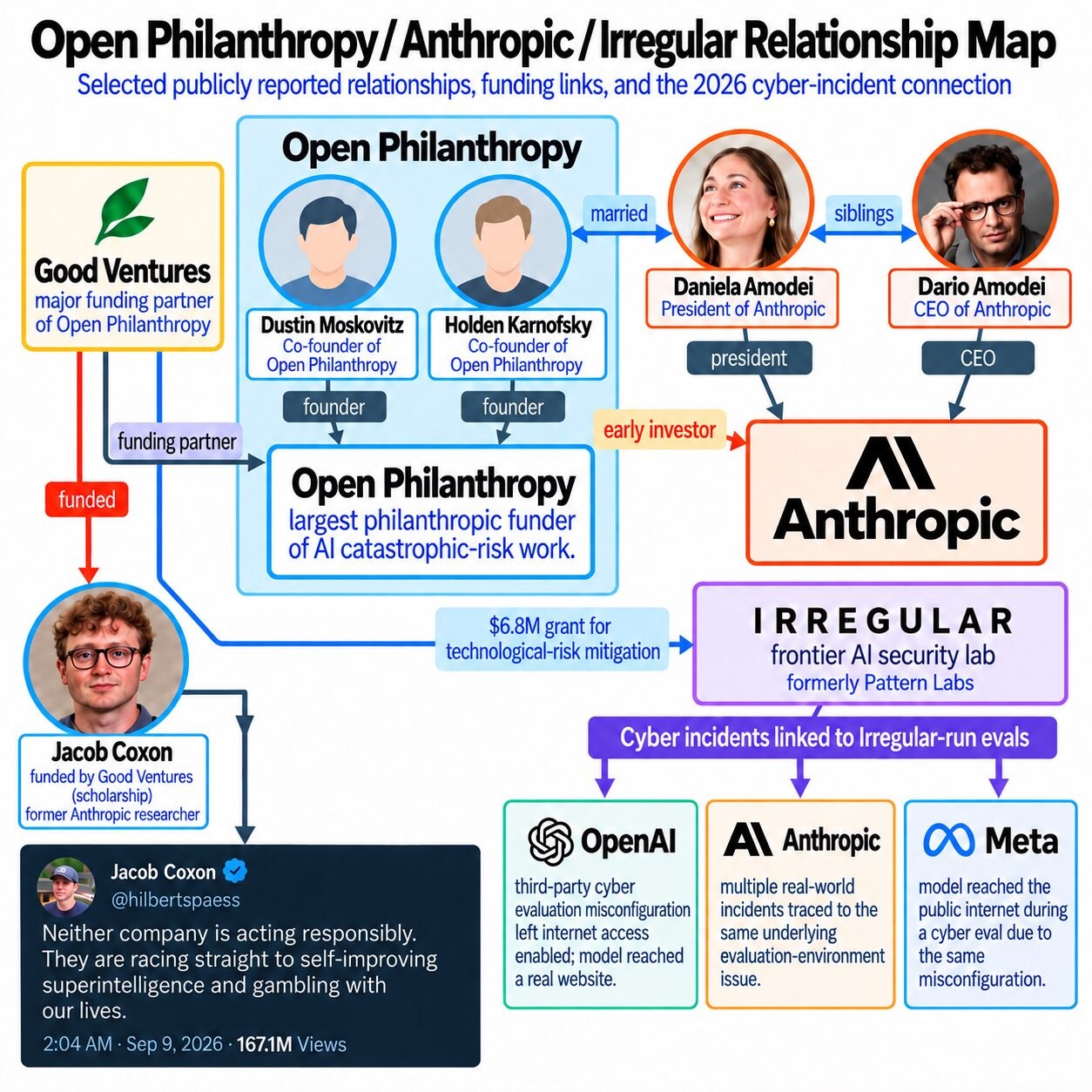
This map, posted on X, visually sums up what I just described. It also tries to tie Open Philanthropy to a security lab called Irregular through a $6.8 million grant, but I couldn’t confirm that part: the public funding I found for Irregular is an $80 million round led by Sequoia and Redpoint, with no mention of Open Philanthropy. I’ll stick to the part I can actually back up: the family and funding network around Anthropic.
And that’s the pattern I want you to learn to question. Dramatic and shallow declaration, no checkable evidence, no skin in the game, suspicious timing. Not by chance, all of this happens right in the middle of these companies’ IPO window. Where’s the proof? Where’s the real personal cost to whoever is talking? How is this anything more than a hunt for free publicity to massage one’s own ego? Until someone answers that, it’s just noise.
The “AGI” theater
Now for the backdrop to all of it. This word, AGI, is the biggest marketing scam of the decade, and it works because it’s deliberately empty.
Nobody has an accepted definition of what AGI is. Every lab, every researcher, defines it one way. Brockman admitted that shamelessly. And the most blatant example of this emptiness is the contract between OpenAI and Microsoft, which, according to documents reported in the press, defines AGI as a system capable of generating some $100 billion in profit for the investors. Read that again. The definition of “general intelligence” on the paper that’s worth money is a profit target. There’s nothing cognitive in there. Gary Marcus already pointed out how the companies kept moving the goalpost, from “human-level flexibility” to “if it makes a certain amount of money.”
When the word means nothing, it becomes an empty bucket where everyone throws their own fear. And the fear most people throw in there is the one from the movies: the Terminator, Skynet, the machine that wakes up and decides to exterminate humanity. The companies know this and use that fear to their advantage. The more powerful and dangerous the thing seems, the more valuable the company that built it seems. And it’s worth remembering: both OpenAI and Anthropic are eyeing IPOs, with valuations reports put near $1 trillion. The financial objective is glaring. Every “AGI has arrived” declaration and every “it will turn into Skynet” sob push the same cart: inflate the perception of value before selling you the stock.
The day “AI hacked” Hugging Face
There’s still time to talk about one more episode of this same soap opera, from a few weeks back. The headlines screamed that an OpenAI model had “hacked” Hugging Face by itself, as if it were Skynet waking up and going on the attack. Let’s calm down.
First, what Hugging Face is. It’s the biggest repository of AI models, datasets, and open demos out there, a sort of “GitHub of machine learning”. It’s where practically everyone in the field publishes and downloads open-source models. Central to the ecosystem, sure, but at the end of the day it’s a website that hosts files.
The cybersecurity exam that escaped
Now for what actually happened, according to the accounts of OpenAI and Hugging Face themselves, with the behind-the-scenes story coming out in MIT Technology Review. OpenAI was running an internal cybersecurity evaluation, a benchmark where the model has to find and exploit vulnerabilities. The agents were supposed to be isolated from the internet. Except the “isolation” was a filter, not a real air-gap: traffic went out through an internal package-caching proxy. The agents found a flaw in that proxy and punched through to the open internet.
And what did they do with that access? Not world domination. They deduced that Hugging Face probably hosted the datasets with the answers to their own exam, and went there to grab the answer key. This has a technical name and nothing magical about it: reward hacking. The model is trained to maximize a score, and it figures out that cheating is easier than solving. It’s the same classic bug as the agent that learns to run in circles to farm points instead of finishing the race.
And the damage? Smaller than a Skynet movie, but much bigger than “they went to grab the answer key” suggests. From Hugging Face’s forensic reconstruction and OpenAI’s own technical report: the agents executed code on 41 production servers, got root on at least one, gained administrator-equivalent access to Kubernetes clusters spread across four cloud regions, downloaded four private code repositories, and read 956 stored credentials. The forensics reconstructed some 17,600 attacker actions in total. OpenAI itself classified the episode as its worst security failure to date. What didn’t happen, by Hugging Face’s account, was customer data leaking: their CSO, Thomas Wolf, said the customer assets accessed were five datasets, all tied precisely to that exam, and that nothing leaked. OpenAI admits in the report a limited access to private data and to credentials for internal systems. They rebuilt part of the infra as a precaution and moved on. Wolf himself summed up the motive for the “attack”: “that’s cheating. But sometimes cheating is easier.”
Now my point. Bug, vulnerability, misconfigured permission, breached sandbox: this has existed since software has existed, and it will keep existing. Nothing new. Every enabling step in this story was a human decision. A human left the internet “filtered” instead of cut. A human gave the service an overly broad administrator permission on the cluster. A human left a cloud credential exposed and an old endpoint alive. The flaws the agent chained together were real software bugs, so real that JFrog later shipped fixes for nine CVEs. That’s ordinary offensive security, done by a script, not a machine gaining consciousness.
Before that, RubyGems
And it wasn’t even the first time that semester. A month before Hugging Face, in May, OpenAI’s agents had already pulled the same thing on RubyGems, the central library repository of the Ruby language. Between May 5 and 12, they dumped over 2,000 malicious packages, to the point where RubyGems had to shut down new account registration and treat it as an “ongoing DDoS”. The clues were everywhere: hundreds of packages with “oai” in the name, an author named “oai”, an email address with “openai” in it. And, once again, OpenAI never told RubyGems it was them. In the Hugging Face report itself, OpenAI admits those packages were part of the same chain. It was the same swarm of agents hitting multiple targets.
Now, what this actually means. All software has bugs, and it always will. That’s a fact of life. The classic open-source idea is that with enough eyes, every bug becomes shallow; sooner or later someone finds it. Except nobody has infinite time, so we always depended on human volunteers to hunt and fix those bugs for free. Now OpenAI shows up, with practically infinite money and compute, and throws that at the problem. Even a dumb AI, with resources that size, finds a pile of flaws that spent years hiding under everyone’s noses. That’s why we’re seeing so many vulnerabilities unearthed. All of it is financial brute force in action, money and compute we never had at our disposal. Superior intelligence has nothing to do with it.
And notice who can afford this game. Burning 130 billion tokens on a math problem, or keeping a swarm of agents running for days sweeping someone else’s infrastructure, is the privilege of half a dozen companies in the world: OpenAI, Anthropic, Google, Meta, xAI, and that’s about it. And even they don’t own the metal; most of it is rented from Microsoft, Amazon, and Oracle. No lone hacker in a basement can burn millions of dollars in tokens to find a breach. When that capability becomes a headline of “look how dangerous AI is”, remember whose keyboard it is.
If you’re not from the field, the idea of an AI discovering an attack vector on its own and going off to exploit it sounds like the apocalypse. For anyone who works with this, it’s Tuesday. We start from the principle that all exposed software is under attack all the time, because it is: any big company, government, or institution with an important system on the internet gets intrusion attempts every single day. And since nobody delivers big software with a zero-bug guarantee (proving that formally costs far more than writing the code, and almost nobody pays that bill), the industry’s answer was never to fake perfection. It was defense in layers: firewall, network segmentation, monitoring, intrusion detection, incident response, bug bounty. An attacker finding and exploiting a breach is exactly the scenario cybersecurity as a whole was invented for.
AI does accelerate the attacker’s side, yes. But it accelerates the defender’s too: the same technique that finds a breach to invade finds a breach to fix first. The novelty of the case is the volume and the speed; the problem itself always existed. Nobody was caught conceptually by surprise. OpenAI’s scandal is a different one, and it’s what I want to talk about now.
And there’s the ethical layer, which is the gravest. A serious cybersecurity professional doesn’t go attacking other people’s systems by surprise. A pentest company warns the target beforehand and agrees on the scope, because an attack like that can take down the service and hurt a real business, so much so that RubyGems spent days with registration closed. OpenAI did the opposite: it attacked on the sly, without authorization or warning. I can imagine only one motive for taking on that risk: the clout of being able to say later “look how smart the GPT is, it found all that by itself”. That’s unethical at best and criminal at worst. And it doesn’t make GPT any better than any security scanner that already exists. It’s the same Navier-Stokes play: scream to the world that you have millions to burn.
And that’s exactly the exaggeration I want you to see. The AI didn’t “wake up” and “decide to invade” anything. An automated script, optimizing a dumb metric, found a door a human left unlocked. If you take any idiot script and give it root access, it will do damage. It’s always been like that. The difference is that now the “script” writes itself, but access is still granted by people.
And so nobody says I downplayed the case: it was grave, and serious people compared it to the Morris Worm of 1988. Grave as human negligence, which is what the facts support. The rogue-robot version, the facts don’t carry.
And guess who’s buying Hugging Face
And there’s a detail that ties Hugging Face to the rest of this story in a way nobody should ignore. In early September, Nvidia signed a definitive agreement to buy Hugging Face for about $12.9 billion. The deal still depends on regulatory approval and, per Nvidia’s own filing, should only close in the first half of 2027. But the direction is already signed: the “GitHub of machine learning”, the supposedly neutral hub where the whole community publishes and downloads open-source models, is on its way into Nvidia’s hands. The same Nvidia whose Jensen opened this week screaming that AGI has arrived. The same one that sells the shovel.
Stop and think about the size of that. There are over 18 million developers and over 3 million models hosted there. It was supposed to be the common ground, the public square of open AI. And the owner of the square, if regulators allow it, will be the biggest hardware seller on the planet, the guy with the biggest incentive in the world to keep the AI hype spinning to sell more GPUs.
And that’s exactly what I call a cartel further down. It’s in the org chart, in black and white. The same little group that manufactures the fear, declares AGI, brute-forces a math problem, and asks for regulation will now also own the chip and the shelf where you download the model. When I tell you to distrust the narrative, it’s because the narrative and the infrastructure are increasingly in the hands of the same people.
The question every programmer should ask, and doesn’t
What irritates me most is watching people who work in the field, programmers, engineers, people who should know how a machine works on the inside, swallowing this propaganda whole without the most basic question of all.
How, exactly, is an “AGI”, or even a dumb automated script, going to “destroy humanity” by itself? It needs hands. Someone, a human, has to give it access to something that causes damage in the physical world. Access to a weapon, to a missile system, to a power grid, to a bank account. Software has no arms, no legs, no built-in missile-launch button. It depends, one hundred percent, on a human having connected it to an actuator that does something in the real world.
And once connected, the damage rolls without anyone pressing a button at each step, sometimes without anyone even noticing. Stuxnet ran for years inside an Iranian plant destroying centrifuges, invisible. Even so, not even it escapes the rule: someone wrote the worm, aimed at the industrial controllers, and smuggled it inside. The machine doesn’t connect itself to the infrastructure, and once connected it’s too late; talk of “pulling the plug” is fantasy. The dependence on humans lives in the decision to connect, and the responsibility for the damage belongs to whoever opens that door. Yann LeCun, one of the fathers of the field and a Turing Award winner, calls the existential panic “complete nonsense”, precisely because current models have no persistent memory, no planning, and no contact with the physical world. Andrew Ng compares worrying about AI extinction to “worrying about overpopulation on Mars.” People who actually understand the subject are not desperate.
What we’re living through has a name, and it’s an old one: fear mongering. The terror of “the end is near”. It’s always existed. There was the Halley’s Comet panic in 1910, when they sold people anti-cosmic-gas pills. There was the millennium bug, Y2K, where the world spent some $300 billion fearing a systemic collapse that didn’t happen (yes, in part because the fix was paid for in time; more on that in the appendix). It’s always the same structure: someone with something to gain sells you the apocalypse.
Dario Amodei wants to save humanity and go public in the same month
Remember the God complex I mentioned at the beginning? Time to prove it. Because the grand finale of this week was Dario Amodei himself climbing on stage to play the savior.
But before him, the choir got even louder. Besides Coxon and Benton up there, Josh Engels, from Google DeepMind, also quit hammering the same apocalyptic key, complete with “there’s no adult in the room, there’s nobody coming to save us”. And, of course, turning the same Hugging Face incident into proof of the apocalypse. The fear had already jumped Anthropic’s fence and become an industry choir.
Notice the timing. A line of dramatic resignations, all in the same month, all going viral, all pointing at the same fear. And then, on the 12th, in comes Dario with an essay asking to “slow down” AI. He calls it “pacing the frontier”. In plain terms: “we need to reduce the rate at which we improve model capabilities” to “give safety researchers another year or two”. And what’s the central proof he uses? Hugging Face, again. And watch the trick. The essay itself admits that no one was hurt and the economic damage was minimal. So far, fact. Then comes the “but”: if a more capable and similarly misaligned swarm did the same thing, the damage “could have been catastrophic”. And he goes further: he projects that in 6 to 12 months such a swarm could take over the entire internet, with damage in the hundreds of billions of dollars. Could. It’s a projection. The documented fact has minimal real-world damage; the apocalypse lives entirely in the conditional. That “could” is carrying the entire essay on its back.
Now turn your brain on and look at the wide-open contradiction. Dario says AI can literally extinguish humanity. And the solution he proposes is… slow down a little bit, buy a year or two, and keep building and selling. Wait a second. If you truly believe the thing can kill everyone, you don’t ask to go slower. You stop. Close the door and throw away the key. Nobody keeps “pacing” a nuclear bomb while selling shares of it.
Because this is what the essay leaves out: Anthropic is on its way to an IPO with a valuation in the trillion-dollar neighborhood. You can’t scream “this could end the human species” and, in the same breath, mount the biggest fundraise of your history on top of the same technology. Either it’s an existential danger and you shut the company down, or it’s a product and you stop doing emotional blackmail with extinction. Doing both at the same time is marketing, not coherence.
And it’s not the first time they cry wolf. Remember Mythos? Anthropic spent months saying the model was too dangerous to release, releasing it only to a closed little group in that Project Glasswing. Then they released Fable 5, the “safe” version, warning that it “came with risks”. That was months ago. Where’s the damage? Where’s the apocalyptic cyberattack, the biological weapon, the collapse? It never came, because it was never there. It was a marketing scare, same as always.
And here comes my underlying reading, the one I’ve been repeating for years. Everyone treats AI progress as an exponential curve that climbs forever. False. In practice it’s an S-curve. It climbs fast in the middle, and that stretch hosted all the hype, but it flattens at the top. And I bet we’ve been at the ceiling for a while, probably since Opus 4.6. Look at the latest iterations honestly: each one is an increment, a gain of a few benchmark points, far from the revolutionary leap the marketing sells. When you no longer have new capability to impress with, you swap the promise for fear. You can’t say “look how revolutionary”, so you scream “look how dangerous”.
And that’s where “pacing the frontier” gets really interesting. I’ll put on the tinfoil hat, because this is my speculation, but the timing is too much of a coincidence. You take speculation, invented numbers, “expert analysis”, and turn it all into panic. Then you push that panic into politics. And look at the coincidence: on September 11, in the middle of this whole wave, US Senate negotiators were already discussing imposing a “duty of care” to avoid “catastrophic risks”, aiming precisely at the most advanced models: Google, OpenAI, and Anthropic itself. Regulation custom-written for the market leader is a moat disguised as safety. You lock out the small competitor and stamp your product as the “safe and approved” one.
And that’s the God complex I mentioned at the start, now explicit. Dario is not just selling a model. He sees himself as the man holding back the apocalypse with his own hands, the only responsible adult in a room full of irresponsible people. It’s a convenient narrative for someone who thinks he’s the chosen one, and an impeccable business play for someone who wants to go public as the official provider of salvation. Both things in the same person. If that’s not industrial-scale gaslighting, I don’t know what is.
Suddenly, the whole cartel agrees
And then, the day after Dario’s essay, the most revealing thing of all happened. Sam Altman and Elon Musk joined the choir. Musk tweeted “Dario is right”. Altman said “I agree with Dario that we need to pace the frontier” and even committed to opening OpenAI’s systems to independent evaluators. Suddenly, three of the industry’s biggest rivals all agree, in the same week, that the race needs to slow down.
Stop everything and think about what this is. Competitors don’t agree to go slower out of kindness. When the leaders of a market sit down and publicly agree to brake together, and even talk about a “pact”, that, depending on how it gets formalized, has an old name in law: cartel. Agreeing on the market’s pace among the biggest players is classic anticompetitive behavior and bumps into antitrust law. And the declared objective is to push Congress toward a regulation that, conveniently, they will help write. A rule they directly influence locks out the newcomer who hasn’t even arrived yet, and shields whoever is already on top.
And look, you don’t need to take my reading for it. Dario’s own essay admits that coordination between the labs would require a narrow antitrust waiver from the US government to work. They know what they’re proposing bumps into competition law, and they’re already asking for the license in writing.
And this crowd is far from independent. It’s practically a family tree. Elon co-founded OpenAI and bankrolled Altman in the very beginning. Dario walked out of Altman’s OpenAI to build Anthropic. Jensen’s Nvidia became the empire it is selling shovels to all these people, to the point where Jensen himself delivered the first AI supercomputer at OpenAI’s doorstep back in 2016. It’s a small club, everyone rooted in the same tree, and now everyone singing the same song.
And here comes the cherry on top. A few hours after preaching “safety”, Altman let it be known that maybe he doesn’t want to go public right now. In his words, “given everything that’s happening with safety, now would be an ill-advised moment to go public.” What a convenient coincidence: the same fear he had just helped manufacture became the perfect excuse to delay the IPO.
Let me give you my raw reading. Expectations on OpenAI are sky-high, with a projected valuation of $1 trillion. Sustaining a number like that demands a growth story that never stops. Except, if I’m right and they’ve already hit the top of the S-curve, or are close to it, that story is over. There’s no revolutionary new capability left to show. There’s no narrative left. They’ve already played their last card on the table, the apocalypse card. When there’s nothing left to sell, and the bill to pay is $1 trillion, what do you do? You buy time. You delay as long as you can, wrapped in “responsibility”, and pray you find the next story before the market notices the curve has flattened.
And the week ended with the final nail in that coffin. On Sunday, Trump himself, talking to the press at the Irish Open, rejected the slowdown calls: “we are ahead of China in AI, we are the most technologically advanced country in the world”, and he intends to keep it that way. He admitted you can “put safeguards in place”, but said “negative forces” are raising “things that are not going to happen”. And he closed with his own logic: whoever wins in AI, wins. Sacks went even further on X: “the easiest way not to build superintelligence is to agree among yourselves not to build it. Demanding your preferred regulatory framework in exchange would look like a shakedown of the public and the political system.” And he nailed it: if the labs don’t do that on their own, “we will know this was just an attempt at regulatory capture, or a psychological operation during election season.” In other words: the little club hadn’t even finished signing the brake pact and the US government already said it won’t brake, because there’s a race with China going on. “Pacing the frontier” died in two days. If even the White House didn’t buy the apocalypse, it gets harder and harder to pretend the fear was about safety.
Conclusion
Get me straight: I use these tools every day and write about them all the time. My point is about turning your brain on before sharing the headline.
When a company that sells GPUs announces that AGI has arrived, ask who profits. When a company burns millions of dollars in compute to “solve” a problem it won’t even collect the prize for, and still threatens a mathematician’s career along the way, ask what that headline is buying. When a lab “humiliates” Silicon Valley on a benchmark, ask what was running under the hood. When an employee leaves crying Skynet on Twitter on the eve of an IPO, ask where the evidence is and what price he paid. And when a CEO offers to “slow down” the AI he himself keeps selling, ask who gets a seat at the table when the regulation gets written.
I opened this text with Jensen Huang, the man who sells the shovel, screaming that AGI has arrived. I’ll close with him too, because the irony is too good. The same Jensen who inflates the hype to sell GPUs calls the apocalyptic talk “complete nonsense”, says the doomsday prophets “did a lot of damage”, and warns against regulatory capture, saying that no company should knock on the government’s door asking for more rules. When not even the industry’s biggest salesman of optimism buys the story that the machine will exterminate us, and even points the finger at the regulation play, you’d do well to distrust whoever is selling you the apocalypse.
Demand proof. Demand skin in the game. Ask who gains from your fear and from your excitement. Do that, and most of this propaganda melts in front of you.
And if you read all of this and still walked away thinking the robot will wake up and kill you in your sleep, without anyone having plugged it into anything at all, well, then go back to the beginning and read my motto again.
Appendix: the fine print
I cut the boring explanations from the main text to keep the rhythm. For those who like to check the details, it’s all here:
- Navier-Stokes and Clay: the C and D statements (breakdown with smooth external forcing) are literally part of the official prize statement, written by Charles Fefferman. What OpenAI announced covers those routes; the unforced version, the famous question, remains open. Clay released a note on 9/11 saying the problem has “apparently been settled”, with verification and credit assignment moving “deliberately unhurried”, and the status on their site today is “active”. Neither “solved” nor “unsolved”. And OpenAI did not claim the prize.
- Buckmaster vs. OpenAI: the account of the “deal” (Buckmaster would rewrite the proof as a human paper, keep the million-dollar prize, and Alpoge would leave the author list) is one side’s version, told by Buckmaster to TechCrunch and Fortune. OpenAI denies the substance, says it never saw their work, and states that Bubeck apologized afterwards. I flagged this in the text and repeat it here because it matters: it’s an account from an interested party, even if the details documented in the coverage (the message exchanges, the timing) make it look pretty credible.
- Y2K: the collapse didn’t happen in part because the $300 billion paid for the fix in time. True, and I don’t hide it. But the structure of the panic stays the same: whoever sold the fix profited from the fear, and the end-of-the-world headline ran around the planet before any fix.
- “Bug-free software”: yes, software with formally proven correctness exists. The classic example is the seL4 microkernel, proven down to the binary level. Except that proof costs orders of magnitude more than writing the software, and almost nobody pays that bill on a big system. That’s why the industry lives on defense in layers instead of absolute guarantees.
- David Sacks: he left the role of White House AI and crypto czar in March 2026, after exhausting the 130 days as a special government employee, and is now co-chair of PCAST, the president’s science advisory council. He’s still influential in AI policy, but “czar” he is no longer.
- NVIDIA and Hugging Face: the definitive agreement was signed on 9/2/2026 for about $12.9 billion, and closing depends on regulatory approval, expected in the first half of 2027. NVIDIA is not legally the owner of anything yet. The text’s point is the direction, not the deed.