[Off-Topic] Man's Rights

I normally don’t like to talk about politics. I hate it. I’ve always thought it was a huge waste of time. However, given the more exaggerated visions of left-wing populism, of ignorance when Cuban tyrant-socialism or the totalitarian Venezuelan dictatorship is glorified; in the face of clamor for re-nationalization and movements against privatization — all based on the idea of “the good for the people,” “for the benefit of the majority,” “to help the weak” and other such nonsense, I thought I could at least offer a small philosophical contribution, translating at least one more chapter from Ayn Rand’s book, The Virtue of Selfishness, which speaks exactly about this topic, remembering, of course, that it was written in the context of the 1960s. But it’s impressive how much things haven’t changed in this regard. But first, another passage from the introduction, regarding the foundation of the “rational egoism” of Objectivism:
Observe the impropriety of what passes for moral judgments today. An industrialist who produces a fortune and a bandit who robs a bank are considered equally immoral, since both sought wealth for their own benefit “selfishly.” A young man who abandons his career in order to support his parents and never rises above the position of a grocery store clerk is considered morally superior to the young man who undergoes excruciating effort and achieves his personal ambition. A dictator is considered moral, since the unspeakable atrocities that were committed were for the benefit of “the people,” not himself.
Observe what this criterion of the morality of benefit does to a man’s life. The first thing he learns is that morality is his enemy, he has nothing to gain from it, he can only lose; self-inflicted loss, self-inflicted pain and the gray, enfeebling shroud of incomprehensible obligation are all he can expect. He may expect that others may occasionally sacrifice themselves for his benefit, as he sacrifices himself unwillingly to them, but he knows that the relationship will bring mutual resentment, not pleasure — and that, morally, his pursuit of values will be like an exchange of unwanted, unchosen Christmas gifts, where none is morally allowed to buy for himself. Aside from moments where he manages to perform an act of self-sacrifice, he has no moral significance: morality takes no notice of him and has nothing to say to him to guide him in the crucial questions of his life, it is only his own personal, private, “selfish” life and, as such, it is considered either bad, or, at best, amoral.
…
Since egoism is “concern with one’s own interests,” the Objectivist ethics uses this concept in its exact and purest sense. It is not a concept that can be delivered to man’s enemies, nor to the unreflective misconceptions, distortions, prejudices and fears of the ignorant and the irrational. The attack on “egoism” is an attack on man’s self-esteem, to give up one is to give up the other.
Chapter 12 – Man’s Rights
If anyone wants to defend a free society — that is, capitalism — he must understand that the indispensable foundation is the principle of individual rights. If anyone wants to support individual rights, he must understand that capitalism is the only system that can sustain and protect them. And if anyone wants to measure the relationship of freedom with the goals of today’s intellectuals, he must measure it by the fact that the concept of individual rights is avoided, distorted, perverted and rarely discussed by so-called “conservatives.”
“Rights” are a moral concept, the concept that provides a logical transition from the principles guiding the actions of an individual to the principles that guide his relationship with others, the concept that preserves and protects individual morality in a social context, the link between a man’s moral code and society’s legal code, between ethics and politics. Individual rights are the means to subordinate society to moral law.
Every political system is based on some code of ethics. The dominant ethics of humanity’s history is a variant of the altruist-collectivist doctrine, which subordinated the individual to some higher authority, whether mystical or social. Consequently, most political systems were variants of the same statist tyranny, differing only in degree, not in basic principle, limited only by the accidents of tradition, chaos, bloody struggle and periodic collapse. Under all these systems, morality was a code applicable to the individual, but not to society. Society was placed outside moral law, as its embodiment or source or exclusive interpreter — and the inculcation of self-sacrificing devotion to social duty was considered as the main goal of ethics in man’s earthly existence.
Since there is no such entity as “society,” since society is only a number of individual men, this meant, in practice, that the rulers of society were exempt from moral law, subject only to traditional rituals, holding total power and demanding blind obedience — on the principle implicit in: “The good is what is good for society (or the tribe, the race, the nation), and the ruler’s decrees are its voice on earth.”
This was true of all statist systems, in all variants of the altruist-collectivist ethics, mystical or social. “The divine right of kings” summarizes the political theory of the first “Vox populi, vox Dei” of the second. Witness: the theocracy of Egypt, with the pharaoh as an incarnated god, the unlimited majority rule or democracy of Athens, the welfare state run by Rome’s emperors, the Inquisition of the Middle Ages, the absolutist monarchy of France, Bismarck’s Prussian welfare state, the gas chambers of Nazi Germany, the slaughterhouse of the Soviet Union.
All these political systems were expressions of the altruist-collectivist ethics and their common feature is the fact that society was above moral law, as a capricious, omnipotent, sovereign worshiper. Thus, politically, all these systems were variants of an amoral society.
The most profoundly revolutionary result of the United States of America was the subordination of society to moral law.
The principle of individual human rights represented the extension of morality into the social system, as the limitation of state power, as the protection of man against the brute force of the collective, as the subordination of power to right. The United States was the first moral society in history.
All previous systems considered man as a means of sacrifice for the goals of others, and society as an end in itself. The United States considered man as an end in himself, and society as a means for peaceful, orderly and voluntary coexistence of individuals. All previous systems had considered that man’s life belongs to society, that society can dispose of him as it wishes, and that any freedom he enjoys is his only by favor, with society’s permission, which can be revoked at any time. The United States decided that man’s life is his by right (meaning: by moral principle and by his nature), that a right is an individual’s property, that society as such has no rights, and that the only moral purpose of a government is the protection of individual rights.
A “right” is a moral principle that defines and sanctions a man’s freedom of action in a social context. There is only one fundamental right (all others are its consequences or corollaries): a man’s right to his own life. Life is a process of self-generated, self-sustaining actions, the right to life means the right to engage in self-generated, self-sustaining actions, meaning: the freedom to take all measures required by nature in a rational way for support, promotion, satisfaction and pleasure of his own life. (This is the meaning of the right to life, liberty and the pursuit of happiness.)
The concept of “right” refers only to action, specifically, freedom of action. This means absence of physical coercion, compulsion or interference from other men. Thus, for each individual, a right is the moral sanction of a positive — of his freedom to act in his own judgment, for his own goals, by his own voluntary choice. As for his neighbors, his rights impose no obligations on them, except a negative type: to refrain from violating his rights.
The right to life is the source of all rights — and the right to property is its implementation. Without property rights, no other right is possible. Since man has to sustain his life by his own efforts, a man who has no right to the product of his effort has no means to sustain his life. The man who produces, while others dispose of his product, is a slave.
Keep in mind that the right to property is a right of action, like all others: it is not the right to an object, but to the action and consequences of producing or earning that object. It is not a guarantee that a man will earn any property, but only a guarantee that he will have his property if he earns it. It is the right to acquire, keep, use and dispose of material goods.
The concept of individual rights is so new in humanity’s history that most men have not fully understood it until today. According to the two theories of ethics, the mystical or the social, some men claim that rights are a gift from God, others that rights are a gift from society. But, in fact, the source of rights is man’s nature.
The Declaration of Independence stated that “men are endowed by their Creator with certain unalienable rights.” Whether one believes that man is the product of a Creator or of nature, the question of man’s origin does not alter the fact that he is an entity of a specific type of a rational being who cannot function successfully under coercion, and that rights are a necessary condition for his particular mode of survival.
“The source of man’s rights is not divine law or congressional law, but the law of identity. A is A and man is man. Rights are conditions of existence required by man’s nature for his own survival. If man is to live on earth, it is his right to use his mind, it is his right to act on his own free judgment, it is his right to work for his values and to keep the product of his work. If life on earth is his purpose, he has the right to live as a rational being: nature forbids him the irrational.” (Atlas Shrugged.)
Violating man’s rights means forcing him to act against his own judgment, or to expropriate his values. Basically, there is only one way to do it: by the use of physical force. There are two potential violators of man’s rights: criminals and government. America’s great achievement was to establish a distinction between these two, forbidding the second from legalizing the activities of the first.
The Declaration of Independence establishes the principle that “to secure these rights, governments are instituted among men.” This provided the only valid justification of a government and defined its only correct purpose: to protect man’s rights, protecting him from physical violence.
Thus, government’s function changed from the role of ruler to the role of servant. Government was instituted to protect man from criminals — and the Constitution was written to protect man from government. The Bill of Rights was not directed against particular citizens, but against government as an explicit declaration that individual rights supersede any public or social power.
The result was the pattern of a civilized society that, for a brief space of about one hundred and fifty years, America came close to conquering. A civilized society is one in which physical force is banned from human relationships, in which government, acting as a police officer, can use force only in retaliation and only against those who initiate its use.
This was the essential sense and intention of America’s political philosophy, implied in the principle of individual rights. But it was not formulated explicitly, nor fully accepted, nor consistently practiced.
America’s internal contradiction was the altruist-collectivist ethics. Altruism is incompatible with Liberty, with capitalism and individual rights. One cannot combine the pursuit of happiness with the moral status of a sacrificial animal.
It was the concept of individual rights that gave birth to a free society. It was with the destruction of individual rights that the destruction of freedom had to begin.
Collectivist tyranny does not dare to enslave a country by confiscating its values, material or moral. It has to be done by an internal corruption process. Just as in the material realm the plundering of a country’s wealth is done by inflating the currency — so today one can witness the process of inflation being applied to the realm of rights. The process involves such growth of newly promulgated “rights” that people do not perceive the fact that the sense of the concept is being reversed. Just as bad money drives out good, so this “rights printing machine” negates authentic rights.
Consider the curious fact that there has never been such a proliferation, throughout the world, of two contradictory phenomena: of new “rights” and of slave labor camps.
The trick was the swap of the concept of rights from the political sphere to the economic.
The Democratic Party platform of 1960 summarizes the swap in a bold and explicit way. It states that a Democratic Administration “will reaffirm the economic bill of rights that Franklin Roosevelt wrote into our national consciousness sixteen years ago.”
Keep clearly in mind the meaning of the concept of “rights” when reading the list this platform offers:
“1. The right to a useful and paying job, in industries or commercial establishments or farms or mines of the country.
“2. The right to earn enough to provide adequate food, clothing and recreation.
“3. The right of each farmer to raise and sell his products at a return that will give him and his family a decent life.
“4. The right of each businessman, large and small, to trade in an atmosphere of freedom from unfair competition and domination by monopolies at home and abroad.
“5. The right of each family to a decent home.
“6. The right to adequate medical care and the opportunity to achieve and enjoy good health.
“7. The right to adequate protection from the economic fears of old age, sickness, accident and unemployment.
“8. The right to a good education.”
A simple question added to each of the eight clauses above would make the issue clear: at whose expense?
Jobs, food, clothing, recreation (!), homes, medical care, education, etc., do not grow in nature. These are man-made values — goods and services produced by men. Who will provide this to them?
If some men have guaranteed by right the products of others’ work, this means that others are deprived of rights and condemned to slave labor.
Any claim of a man’s “right” that implies the violation of another’s rights is not and cannot be a right.
No man can have the right to impose an unchosen obligation, a duty without reward or a right of involuntary servitude on another man. There cannot exist anything such as “the right to enslave.”
A right does not include the material implementation of that right by other men; it includes only the freedom to earn such implementation by one’s own effort.
Note, in this context, the intellectual precision of America’s Founding Fathers: they spoke of the right to the “pursuit of happiness,” not the right to happiness. This means that a man has the right to take the actions he considers necessary to achieve his happiness, but it does not mean that others must make him happy.
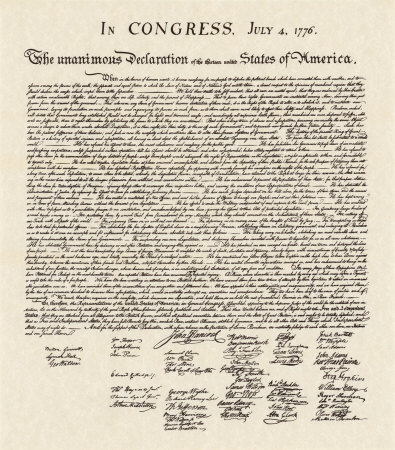
“We hold these truths to be self-evident, that all men are created equal, that they are endowed by their Creator with certain unalienable Rights, that among these are Life, Liberty and the pursuit of Happiness.” – Thomas Jefferson
The right to life means that a man has the right to support his life by his own work (at any economic level, as high as his ability can take him), but it does not mean that others must provide him with life’s necessities.
The right to property means that a man has the right to take the economic measures necessary to earn his property, use it and dispose of it, but it does not mean that others must provide him with this property.
The right to freedom of expression means that a man has the right to express his ideas, without risk of suppression, interference or punitive action by the government. It does not mean that others must provide him with a classroom, a radio station or a printing press to express his ideas.
Any enterprise involving more than one man requires the voluntary consent of each participant. Each of them has the right to make his own decision, but no one has the right to force his decision on others.
There is no such thing as a “right to a job,” there is only the right of free trade, which is a man’s right to have a job if another man chooses to hire him. There is no right to “a home,” only the right of free trade: the right to build a home or buy one. There are no rights to a “just” salary or a “just” price if no one chooses to pay for that, hire a man or buy his product. There are no “consumer rights” to milk, shoes, movies or champagne if no one chooses to manufacture such items (there is only the right to manufacture them yourself). There are no “rights” for special groups, no “rights of farmers, workers, businessmen, employees, employers, the elderly, the young.” There are only Man’s Rights — rights possessed by each man individually and by all men as individuals.
Property rights and the right of free trade are the only “economic rights” of man (they are, in fact, political rights) — and there cannot be such a thing as an “economic bill of rights.” But note that the proponents of the latter have done everything to destroy the former.
Remember that rights are moral principles that define and protect a man’s freedom of action, but do not impose obligations on others. Citizens are not a threat to others’ rights or freedoms. A citizen who resorts to physical force and violates others’ rights is a criminal and men have legal protection against him.
Criminals are a small minority at any time or country. And the harm they have done to humanity is infinitesimal compared to the horrors — the bloodshed, the wars, the persecutions, the confiscations, the famines, the slaveries, the wholesale destruction — perpetrated by humanity’s governments. Potentially, a government is the most dangerous threat to men’s rights: it holds a legal monopoly on the use of physical force against legally disarmed victims. When unrestricted and unlimited by individual rights, a government is man’s mortal enemy. It is not as protection against private actions, but against government actions that the “Bill of Rights” was written.
Now observe the process by which this protection is being destroyed.
The process consists in assigning to particular citizens the violations constitutionally forbidden to Government (which particular citizens have no power to commit) and thus freeing government from all restrictions. The swap is becoming increasingly evident in the realm of freedom of expression. For years, collectivists have propagated the idea that an individual’s refusal to finance an opponent is a violation of the opponent’s right to freedom of expression and an act of “censorship.”
It’s “censorship,” they say, if a newspaper refuses to employ or publish writers whose ideas are diametrically opposed to its policy.
It’s “censorship,” they say, if businessmen refuse to advertise in a magazine that denounces, insults and smears them.
It’s “censorship,” they say, if a TV sponsor opposes some outrage perpetrated in a program he is financing, such as the Alger Hiss incident being invited to denounce former Vice President Nixon.
And then there’s Newton N. Minow who declares: “There is censorship by popularity, by advertisers, by networks, by affiliates that reject the programming offered to their areas.” It’s the same Mr. Minow who threatens to revoke the license of any station that does not comply with his opinion on programming — and who claims that this is not censorship.
Consider the implications of such a trend.
“Censorship” is a term that only applies to government action. No private action is censorship. No particular individual or agency can silence a man or suppress a publication; only the government can do that. Individuals’ freedom of expression includes the right not to agree, not to listen and not to finance their own antagonists.
But according to doctrines like the “economic bill of rights,” an individual does not have the right to dispose of his own material means through the guidance of his own convictions — and must deliver his money indiscriminately to any talker or propagandist who has the “right” to his property.
This means that the ability to provide the material tools for expressing a man’s ideas deprives him of the right to have property over any idea. This means that a publisher has to publish books he considers useless, false or bad — that a TV sponsor has to finance commentators who choose to affront his convictions — that a newspaper owner must turn his editorial pages over to any young hooligan who clamors for the enslavement of the press. This means that a group of men acquires the “right” to unlimited license — while another group is reduced to helpless irresponsibility.
But since it is obviously impossible to provide any claimant with a job, a microphone or a newspaper column, who will determine the “distribution” of “economic rights” and select recipients when the owners’ right of choice has been abolished? Well, Mr. Minow indicated this very clearly.
And if you make the mistake of thinking that this applies only to large owners, better realize that the theory of “economic right” includes the “right” of each aspiring writer, each young poet, each noisy composer and each non-objective artist (who sucks up to politicians) to the financial support you didn’t give them when you didn’t attend their shows. What else is the meaning of the project to spend your tax money on subsidized art?
And while people are complaining about “economic rights,” the concept of political rights is disappearing. It is forgotten that the right to freedom of expression means the freedom to defend points of view and face the possible consequences, including disagreement with others, opposition, unpopularity and lack of support. The political function of the “right to freedom of expression” is to protect dissident and unpopular minorities from violent repression — not to guarantee them support, advantages and rewards of popularity they haven’t earned.
The “Bill of Rights” says: “Congress shall make no law … abridging the freedom of speech or of the press …” It does not require private citizens to offer a microphone to the man who defends their destruction, or a key to the thief who wants to rob them, or a knife to the murderer who wants to cut their throats.
Such is the state of one of today’s most crucial issues: political rights versus “economic rights.” It’s either-or. One destroys the other. But there is no such thing, in fact, as “economic rights,” “collective rights,” “public interest rights.” The expression “individual rights” is a redundancy: there is no other type of rights and no one else to possess them.
Those who defend laissez-faire capitalism are the only defenders of man’s rights.