Off-Topic: Understanding the Economic Crisis

Nassim Taleb and Benoît Mandelbrot must be watching this crisis, tragically, through very different eyes from ours. Some people are probably tired of hearing it, but I’ll repeat my recommendation: read both.
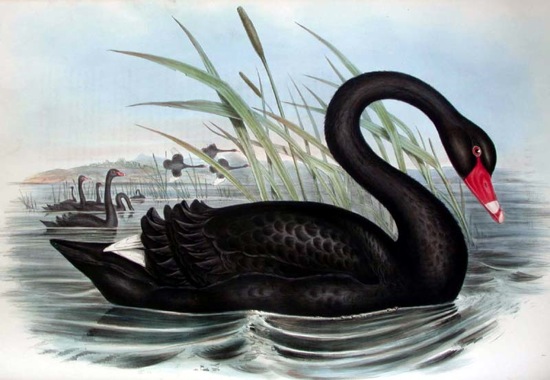
Take this excerpt from The Black Swan, published in 2007, by Nassim Taleb:
Globalization creates interlocking fragility, while reducing volatility and giving the appearance of stability. In other words it creates devastating Black Swans. We have never lived before under the threat of a global collapse. Financial institutions have been merging into a smaller number of very large banks. Almost all banks are now interrelated. So the financial ecology is swelling into gigantic, incestuous, bureaucratic banks — when one falls, they all fall. The increased concentration among banks seems to have the effect of making financial crisis less likely, but when they happen they are more global in scale and hit us very hard. We have moved from a diversified ecology of small banks, with varied lending policies, to a more homogeneous framework of firms that all resemble one another. True, we now have fewer failures, but when they occur … I shiver at the thought.
The government-sponsored institution, Fannie Mae, when I look at its risks, seems to be sitting on a barrel of dynamite, vulnerable to the slightest hiccup. But not to worry: their large staff of scientists deemed these events “unlikely.”
No, Nassim is not a prophet, a fortune teller, or a guru. He’d actually hate being called a guru. He just made an observation based on what all of us ignore: the human machine is lousy at dealing with abstractions, like Randomness.
Don’t get me wrong: this is no argument against globalization, nor any pseudo-socialist nonsense. The important part is the second paragraph of the quote.
It’s Happened Before
Long-Term Capital Management was the darling of the financial world: an American hedge fund formed in 1994 that had among its founders not one, but two Nobel laureates in Economics, Robert C. Merton and Myron Scholes. They believed they had the mathematics (cough Gaussian cough) to predict any kind of event.
In 1998, LTCM lost USD 4.6 billion. The Russian crisis destroyed their Gaussian theories, which completely ignored and underestimated Black Swans.
And you think people learned the lesson? Unfortunately we’re more stubborn than that: Scholes and Merton’s theories are still taught in economics programs to this day.
This is no exclusive trait of the economic world. Plenty of other fields accept and employ absurd theories, with no foundation and no results, and still treat them as the next great revolution. Ordinary people let themselves be fooled by names and credentials. If credentials were worth anything, a Nobel destroyed in 1998 should mean something.
I often say this: companies and charlatans who sell methodologies (of any kind: financial, human resources, management) have the easiest job in the world. All they need is to be good salespeople.
If the client succeeds after implementing the methodology: “See? You succeeded because you implemented our revolutionary methodology.” And that client becomes a “success story” in the portfolio.
If the client fails: “Of course it failed. You didn’t implement it exactly as we said, your teams lacked commitment. There’s nothing wrong with our methodology; the problem is you.” That client will never show up in the portfolio, since nobody likes to publicize failure.
Fooling people is very easy. And don’t look sideways: you’re implementing one of these methodologies today. I know it.
Falsifiability

People have the nasty habit of asking the wrong question: “how do we know if a theory is true?” That’s how they get the wrong answers, which lead to even worse decisions.
As I’ve said several times in previous articles, we are built to be fooled. Worse: we consciously refuse to exercise our skeptical muscles.
Every time we see a “success story,” we automatically accept the theory as “true.” Or, in an even more twisted version: “I’ve never heard of a case where this methodology failed, so it must be valid.” That’s what most “managers” and “executives” conclude. How many times do we need to repeat this?
Absence of evidence is not evidence of absence.
Today we use a lot of statistical data to make decisions. Statistics is very useful when used the right way. Used the wrong way, it’s an enormous disaster.
The reasoning is always the same: “for the last 3 years we’ve been growing 2% every month, so we can conclude with certainty that we’ll keep growing 2% in the coming months.” Everyone has done this. Until a Black Swan shows up and the excuse changes: “I don’t know what happened, it was an accident, because according to the data this shouldn’t have happened.”
Let’s be crystal clear: a rare event is called rare precisely because it doesn’t happen all the time. And it’s exactly this kind of rare, random, unpredictable event that usually delivers the billion-dollar losses or the billion-dollar gains. It depends on whether you’re the Gaussian type or the Paretian type.
But back to the original problem: is past statistical data enough to guarantee a theory’s validity?
Obviously NOT.
The most that past data can do is guarantee a theory’s falsifiability. As Nassim explains in Fooled by Randomness: with past data we can prove a theory is invalid, but we can never prove it is valid.
Today we know Newton’s classical physics is invalid, because Einstein’s Theory of Relativity overturned it. But we know in which contexts classical theory can still be used and when we need relativity. Good scientific theories are the ones that provide criteria to judge their falsifiability, never their validity.
Astrology and other pseudo-sciences are dogmatic. Anything dogmatic should be automatically discredited, since it blocks any attempt to check its falsifiability. That’s the signature of charlatans.
The argument I described in the previous section is exactly what charlatans do: if it worked, credit the theory; if it didn’t, you applied it wrong. The prediction failed despite Mars being aligned with Saturn because Mars was “a tiny bit” off position. Otherwise it would have worked.
Nassim gave another great example: “I have just completed a thorough statistical examination of the life of President Bush. For 55 years, close to 16,000 observations, he did not die once. I can hence pronounce him as immortal, with a high degree of statistical significance.”
Fallacies

Lately I’ve given several tips on things to avoid. If the subject is management or control, especially of people, and the theory doesn’t take Pareto into account, throw it out.
If a theory leaves no room to evaluate its falsifiability, it’s charlatanism. Throw it out.
Self-help books work like that: they offer flowery theories, covered in honey, attractively packaged. But unlike scientific theories, they never let anyone try to prove they don’t work. They only assert that they work, cite “success stories,” and hide every failed attempt.
Since the beginning of last month I’ve been traveling every week to give talks, and I always stop by the airport or bus station bookstore. Paying closer attention, the featured books are almost all of this kind: cheap charlatanism.
The “beautiful” theory only exists today because it hasn’t met a Black Swan on its path yet. “Ah, it’ll never happen, because it never happened before.” And that’s exactly why it may have even better odds of happening: because it never has!
Watch out for the following fallacies:
Induction Fallacy: the fallacy where induction goes wrong. Induction means trying to find general principles from known facts.
Narrative Fallacy: the creation of a post-hoc story so that the event seems to have had an identifiable cause.
Regressive Statistical Fallacy: believing that the probability of future events is predictable by examining occurrences of past events.
Ludic Fallacy: believing that the structured randomness found in games resembles the unstructured randomness found in life. It’s the problem of confusing the map (model) with the territory (reality).
The last one takes into account:
- it’s impossible to have all the information
- very small variations in the data can lead to enormous impact (the Butterfly Effect, and yes, it happens all the time)
- theories and models based on empirical data are flawed, since events that haven’t happened yet can’t be taken into account
It’s the example Taleb explains: you’re drawing colored balls from a covered box, without seeing inside. You pull 5 white balls and 5 red balls and, from this empirical data, conclude that "always 1 red ball will come out for every 2 balls drawn." Little do you know there’s a hole under the table with a boy hiding in it. Hearing your claim, he starts handing you more white balls than red ones. That’s reality.
We exercise our skepticism far too little. Nobody needs to become paranoid, but we could all evaluate things a little better than the mediocre way we do today.
Emotions

As Malcolm Gladwell says in Blink, we do make decisions in the blink of an eye. Of course, the decision will be as good as our experience, knowledge, and skills.
Taleb describes the case of a person who needed brain surgery because of a tumor, and the doctors had to remove the part of the brain responsible for our emotions. Everything else remained intact.
“Excellent!” someone might think. Here is a 100% rational person, who won’t let emotions get in the way of reason, and who should be making smart decisions all the time.
Surprise: this person became completely incapable of making any decision. They could barely decide to get out of bed. The studies show that our decisions are driven far more by the emotional part than by the rational one, contrary to what we imagine.
Anyone who has worked with artificial intelligence concludes that we humans need an approximation mechanism, because it’s simply impossible to take every variable into account. Evaluating everything we know would take so long that predators would have wiped us out millennia ago.
Deciding in the blink of an eye, or worse, trying to be “rational,” has advantages and disadvantages. Open-minded, highly studious people, experienced in many fields, will probably make many right decisions very fast (some by luck, some wrong). Closed-minded, mediocre people will make many wrong ones.
An example of a wrong decision: trusting pseudo-science salesmen.
Karl Popper used to say one should not take science too seriously. It makes sense: science allows itself to be wrong and refines itself over time. If you take everything too seriously, you risk betting on theories that haven’t been truly put to the test, and your next decision may be the very Black Swan that falsifies them.
Conclusion
Be very, very careful with experts. Without denigrating every kind of expert, because many are genuinely good: experts in abstract, intangible things like “methodologies” and “economics” should always be viewed with suspicion. A good credential doesn’t make a theory better or worse. It’s simply irrelevant.
Don’t let your decisions be biased by non-scientific theories: pseudo-science, superstition, astrology, homeopathy.
Again, read Taleb: what he says is obvious, but for some reason we all ignore it. Few people truly understand randomness. Stop frantically watching Bloomberg and refreshing your browser every 5 seconds to check financial indices. None of that will help you: you already ignored the Black Swan, you already lost.
Just a hint about Agile philosophy: I’ve always found it smart that Agile methodologies insist so much on short Sprints and iterations. They know predicting the long-term future is impossible, so they prioritize what really matters and plan only the short term, what’s effectively possible. Agile methodologies look tailor-made to defend against the Black Swans that still haunt traditional software development teams, as I explained in my previous article.
Everyone only ever saw white swans in the past and infers that Black Swans don’t exist. That’s where the danger lies!