Off Topic: Enemies of Reason
My blog has nothing to do with religion, but everything to do with formation. Not just technical formation, but the formation of will. I don’t value someone who studies with the sole immediate goal of earning a certificate. I do value someone who studies purely for their own enjoyment — not with the short-term objective of an exam at the end of six months, but out of a genuine desire to learn. This article is inflammatory; I run the serious risk of losing readers… what can you do? ;-)

In that sense, religions and superstitions do have some problems. That doesn’t mean religious believers can’t be excellent programmers. They are! There’s the mistaken view that atheists like me, when we talk about religion, are doing so exclusively to slander, badmouth, or ridicule. Slow down — we’re not that bad. Just as we’re not racists by skin color, we’re also not racists by belief. Our problem is when the devaluation of evidence in favor of superstition leads to harm — like the setback in stem cell research development. Or when someone abandons serious medical treatment for a glass of homeopathic water.
It’s interesting to note how many discussions in the technology world have a large irrational component: my language is better than yours, my process is better than yours, my Linux is better than your Mac, my Ruby is better than your Java. People assume there’s an absolute Right and Wrong. For one to win, the other must lose. If mine is obviously the Right one, the other’s is, obviously, the Wrong one. As Einstein would say (in another context, I know), everything is relative.
You’ve probably noticed in older articles where I mention many times that I don’t root for any team: I’m a Ruby programmer, but I have no problem opening Visual Studio and writing some C#. I have several Macs, but I have no problem optimizing a Windows or Linux setup. And so on — anything that can help me improve my knowledge is welcome. What’s the practical point in self-limiting?
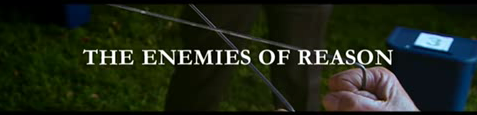
The motivation for writing this came from two videos from Channel 4 in England — a two-episode documentary called “Enemies of Reason,” which can be watched in full on Google Video (episode 1 and 2). The host is none other than one of my favorite non-technical book authors: Dr. Richard Dawkins. Biologist, fierce defender of evolutionism, creator of the term Meme — coined for the first time in the excellent book The Selfish Gene.
He’s also the author of my recent favorite book: The God Delusion, which is about to be released in Brazil as Deus, um Delírio. This book spawned another Channel 4 documentary — which I also highly recommend — called The Root of All Evil?, also available on Google Video here and here (the second episode is titled “The Virus of Faith”).

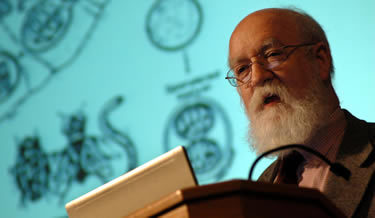
Dawkins is part of a — much criticized — new generation of Atheists, called the New Atheists, which also includes other authors and thinkers like Sam Harris (author of “The End of Faith”) and philosopher Daniel Dennett (author of “Breaking the Spell: Religion as a Natural Phenomenon”).
The biggest problem is fanaticism. There are non-fanatical religious people (fortunately the majority). But the fanatical minority is dangerous, and many of them sit in positions of power, shaping everyone’s future. We’ve already been through an era of religious alienation, known as the Middle Ages. We’re lucky to be a post-Renaissance generation. It makes no sense to regress out of sheer lack of reason.

Beyond all the political and cultural implications, what personally bothers me is the lack of self-worth. I’m not talking about being absolutely arrogant — someone who “thinks” they know everything without knowing anything. But the simple “Thank God” is an unconscious brake. If you’ve achieved something, the credit belongs exclusively to you and your collaborators. Luck helps, but luck isn’t a miracle — it’s just a statistical event. Nothing is impossible. Some things are just probabilistically more unlikely.
If you haven’t achieved something, it’s not God’s fault: it’s entirely yours. I feel like many people have difficulty accepting responsibility — for both successes and failures. The blame/credit for your actions is exclusively yours. Live with it.
Another thing that bothers me: all the materials I’ve mentioned above will be heavily criticized — maybe I’ll get a flood of critical comments, as usual, or perhaps I’ll just be ignored. Even so, prejudices will cause many people to simply refuse to look. That’s another problem: the path of learning demands reason and logical reasoning based on solid evidence. It’s been a century since Charles Darwin published his “Theory of Evolution,” and none of us in the sciences have been arrogant enough to elevate it to the “Law of Evolution.” In the same way, in technology, nobody can claim “My Technology Is Superior.” It’s relative — nobody here has the authority to create a Law proving such a claim, and that’s what we need to keep in mind in order to create a consciously investigative environment: “if mine isn’t the best, what are the alternatives? what’s the evidence? what are the circumstances?”
Joseph Campbell would say that societies need mythologies, heroes, beliefs. It’s a way of explaining things we don’t know, of communicating what is considered Right or Wrong within a given period of time (since the concepts of Right and Wrong vary across space and time). As we evolve, we kill one God at a time. Ra, Isis, Osiris, Apollo, Artemis, Poseidon and many others. We explain where the Sun rises and sets, what exists in the Sky, where we come from, where we’re going, and a ton of other natural events.

As Richard Dawkins said, we miss Carl Sagan. For me, he produced two of the most inspiring works: the “Cosmos” series and the book The Demon-Haunted World: Science as a Candle in the Dark. Every child should be encouraged to watch the entire Cosmos series and learn to think for themselves — truly, free from dogmas and superstitions.
As Dawkins noted in the documentary: astrology books and other superstition titles outsell science books at a rate of 4 to 1. Even in documentaries we have superstitious productions that peddle fairy tales using science as a pretext, like the dreadful DVD “What the Bleep Do We Know?”.
In a competitive world, with numerous problems to solve — diseases, conflicts, global warming, resource scarcity — we need the largest number of non-superstitious, skeptical minds in history. Only then can we take steps forward rather than stagnating in the magic tricks of the past. And even without considering the big questions, as individuals evolving, we cannot and must not become enemies of reason.
Definition of Science: from the Latin “scientia” or “knowledge.” According to Webster’s New Collegiate Dictionary: “knowledge attained through study or practice,” or “knowledge covering general truths of the operation of general laws, as obtained and tested through the scientific method and concerned with the physical world.”
Science refers to a system for acquiring knowledge. This system uses observation and experimentation to describe and explain natural phenomena. The term science also refers to the organized body of knowledge that people have gained using that system.
Science is an elegant system because the scientific method is simple and coherent (Observation/Research, Hypothesis, Prediction, Experimentation and Conclusion), yet rigorous enough to be reliable — principally because, by definition, it has self-correcting mechanisms. It is independent of personal opinion, belief, or point of view. The Law of Gravity is the same for everyone, regardless of race, culture, ideology, age, or social condition.
No hypothesis earns the character of “Law” unless there is solid enough evidence for it. Furthermore, every theory (or hypothesis — definition: a suggested explanation) can be discarded if solid contrary evidence appears.
Definition of superstition: (1) an irrational belief about an object, action, or circumstance not logically related to a course of events that is believed to influence its outcome. (a) An irrational belief, practice, or ritual maintained by ignorance of the laws of nature or by faith in magic or chance. (b) A state of mind resulting from such ignorance or irrationality, characterized by fear or apprehension. (c) Idolatry.
Finally, the definition of Dogma: (a) something held as an established opinion; especially: defines an authoritative principle. (b) a code of such principles (pedagogical dogma). (c) a point of view or principle put forth in an authoritative manner without adequate grounds. (d) cannot be disputed or questioned.