A Rant, Part II

“A consultant is like a hooker: paid by the hour, does what the client wants, when the client wants it, and the one who pockets the money is the pimp.”
Yes, I’m a consultant. And there’s one piece of advice I love to give: keep two eyes looking forward and one looking back. Anyone who follows this blog knows I spent 5 years at the same consulting firm. That’s too long. One more thing to remember: don’t stay more than 3 years in the same place, especially if you’re under 30.
In 10 years I switched companies about 5 times, and inside the firm I hopped across several clients. It’s stressful, granted, but worth it. If you stay open to learning, you’ll pick up solid lessons for the future.
Consulting firms are particularly dangerous, the small ones above all, and even more so when they resemble my former employer. One of the reasons I left (there were several) was the late paychecks. Wait, not paychecks. Invoices.
Remember: when you work as an incorporated entity, the relationship stops being boss and employee and becomes client and vendor. You deliver a service, issue an invoice, and bill for payment.
Back in 2004 we had already been through a similar crisis. And mind you, consulting is a business that practically can’t lose money. They hire you at R$ 50 an hour and sell you to the client for up to R$ 100. That’s a markup of up to 100%. I’ve seen grunts who make under R$ 40 an hour being billed out at R$ 250.
For the consultant, the firm works like insurance: you outsource to them the hassle of dealing with clients, chasing projects, and managing allocations. It’s like a health plan: you pay a monthly premium and, in return, they’re obligated to keep you steady, paying on time and placing you on good projects.
Do the homework and the firm always has a healthy reserve; cash flow is simple. It’s a gold mine. Especially in a world like SAP, where consultants command artificially inflated rates thanks to the limited, pornographically expensive pipeline for certifying new consultants, of abysmal quality, I might add. Clients pay through the nose for lousy service and don’t complain: the perfect racket.
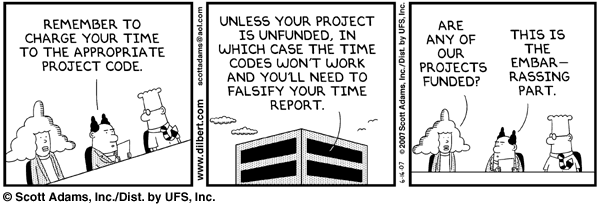
When a consulting firm shows signs of financial trouble, that’s the red flag: jump ship as fast as you can, no second thoughts. If the client throws a tantrum, delays an invoice, or stalls, that’s the firm’s problem. That is exactly what we pay that insurance for: so the firm stands between the client and you. A consultant who works the hours logged correctly has the right to be paid on the dates in the contract.
“A deal’s a deal.”
When that doesn’t happen, it’s a sign of administrative incompetence and of deep disrespect toward the consultant, the firm’s actual workforce. At bottom, it’s plain stupidity: shooting yourself in the foot. A consulting firm is nothing but a bureaucratic apparatus whose single obligation is to manage itself.
The “we’re investing heavily in the company’s future” excuse doesn’t stick. Sacrificing payroll is stupid spending. You don’t mess with the basics. Would you skip your home’s electricity bill to buy a computer? I doubt it, because the power will get cut, and then the computer is useless.
The curious trap I see so many people fall into is believing. When we’re young, we sometimes think we’ve found the next Steve Jobs: the visionary who breaks every mold and will change the world. BE CAREFUL. It’s the old con game: there has been exactly one Steve Jobs in the last 30 years. The math is clear: the far likelier bet is that he’s just a starry-eyed narcissist.
And you’ll end up working for free for him, killing yourself for him, sacrificing your personal life. For nothing.
I’ll repeat the warning: from politicians to cheap hustlers, they all have excellent speeches. Seductive talk, the kind that almost convinces you to drop your pants, work for free, and sacrifice yourself for nothing. Remember the client-vendor relationship? However “valued” you think you are, as a consultant you’re a resource: an outsourced one and, by definition, replaceable.
Nothing wrong with that, as long as you put yourself in that position. You are NOT a partner in the company, and the firm’s fate is not in your hands, however much we’d like to believe it. When the rope tightens, you’re the one left hanging.
That doesn’t give you a license to slack off. Give it your all, but do it for yourself. Treat the late nights as an investment in your own learning, one that happens to help the company along the way.
I’ve told a few people this story, but here it goes again. I wanted to put a down payment on an apartment last year. Since I didn’t trust the firm’s health, I didn’t. I also traded in my car last year and could have paid cash. After an hour of number crunching (learn to use the HP-12C!), I chose to finance.
It all paid off: I kept my liquidity. And that liquidity is what bankrolled the decision I made last month: abandoning a sinking ship.
Lucky for me, Surgeworks crossed my path right around then. But I wasn’t counting on it. Always plan for the worst case: months of unemployment. You need reserves with good liquidity for those stretches.
You can also shrink the worst case. That’s where my earlier articles about being self-taught and investing in your learning and your network come in: I figured I could end up unemployed, yet I got several good offers on the same day, and firms still call to this day. Keep your options open, both in knowledge and in cash, so you never have to take scraps from anyone. Do that and you’ll rarely have trouble.
This warning matters. I’ve seen ugly scenarios, and they made me cautious. Never bite off more than you can chew, never depend on anyone. Never let anyone “take care” of you: own and know your own books, budgets, and taxes.
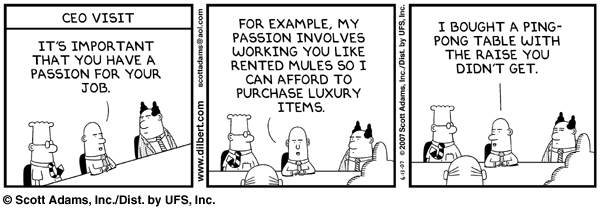
Even if you’re a regular employee at a company that starts showing these symptoms, prepare your exit. Stop being dazzled and don’t take on big debts you don’t need. And above all: don’t get swept up by speeches. When times are good, you’re “highly regarded,” they treat you well, and every now and then you even get a small raise or some trinket.
Even so, you’ll be working for less than you’re worth. And when things get ugly, they’ll call you in to “help out,” unpaid, sacrificing your personal life all over again.
If you choose to leave, all that “regard” goes down the drain: you become the backstabber, the guy who bailed when they needed you most, blah blah blah. Don’t be intimidated. If the company is going under, that’s on them: they broke the bond of trust first.
In my case, in 5 years I never burdened the company, not even by taking vacation. Last year I worked hard, consecutive Saturdays, no holidays. The day I announced I was leaving, what was the first thing I heard? “You know there’s a termination penalty.” There went the “regard.” The pompous speech of yesteryear vanishes and the naked truth shows up. That’s when the masks come off.
It didn’t surprise me or frustrate me, because I practice what I preach: I plan for the worst case. And it happens. Big surprise. Another page turned.
I left with over a month and a half of payments in arrears. I send collection emails, and you know what I hear back? “I’ll pay you R$ 1,000 a month, starting at the end of July.” Amazing how low a company can sink. I feel like I’m begging change from a beggar. What can you do? Almost nothing beats nothing. I just want what’s mine, and that’s another thing to remember: what’s yours, you collect.
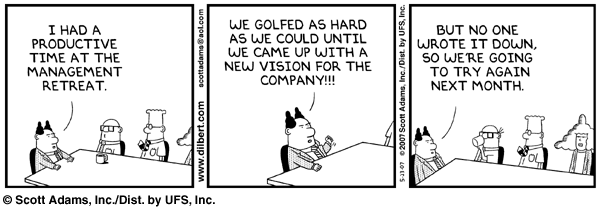
Five years delivering every project successfully, keeping every client happy, pulling all-nighters, working holidays, skipping family weekends, not taking my wife on a trip in the last 4 years, not even making it to my grandfather’s funeral. In the end, that’s how a “resource” gets treated: like just another “resource.”
Use consulting firms the way they use you. They’re still a “way in” to plenty of clients, especially the big-name ones, which are usually backwards, crony-ridden, and highly inefficient. But names like that look good on a résumé, and everyone needs to suffer through an inefficient company to learn how not to do things.
Do good work. Grow. Learn. But be very careful: hustlers are a constant in this market.