Off Topic: Be Arrogant!
It’s sad to see how much people waste of what the worldwide internet community has to offer. I know, I know: it’s English. Always English.
Today’s topic starts with the difficulty of learning English. I’ll wander a bit through my own experience and try to provoke you.

- I can’t read English well enough, so I only read translated books
- I can’t read English well enough, so I only read Brazilian sites
- I can’t understand English well enough, so I only listen to Portuguese-language shows
- I’m too lazy to read subtitles, so I only watch dubbed films
Every now and then I see these childish displays of anti-Americanism, usually from kids wearing Nike, watching ESPN, eating at McDonald’s, and listening to Coldplay and Dream Theater. I think to myself: why do I sense, beneath all that fury, a hint of envy, insecurity, and low self-esteem?

I don’t know if that’s really it, and I have zero interest in digging deeper, but that’s what it looks like. Honestly. Everyone criticizes what they think they can’t have, to disguise the pang of envy. Money can’t buy happiness, yadda yadda. Americans are imperialists, yeah yeah yeah.
Whatever.
Meanwhile, when asked if they know English, out come the standard answers:
- I can read reasonably well, but I don’t listen very well
- I can understand a bit, but I don’t write well
- I’m still taking a course, but I understand more or less
Honestly, when someone asks me a direct question, I give a direct answer. If they ask Do you know English?, I answer Of course.
Arrogant? Of course it is. Nobody achieves anything without a dose of arrogance, alongside other important traits like ambition and skepticism. But let’s analyze arrogance first.
Yes, No, and Maybe
I’m not talking about the type who claims to know everything while knowing nothing. That’s not arrogance, it’s stupidity, pure and simple, because sooner or later the mask slips. Or almost always: sometimes a complete idiot does well anyway, because he was lucky enough to surround himself with people inferior to him. In the land of the blind…
As a friend of mine put it: it’s a sin to leave an idiot with his own money. True.
You need to be arrogant, very arrogant. The only legitimate way to be arrogant is knowing exactly what you’re talking about. If you have the guts to say you can stop a truck with one hand, you’d better actually be able to, because I will absolutely put a truck in your path. That’s what I expect people to do with me.

If someone asks me Do you know X?, I have only two direct answers: Yes or No. Saying no once in a while is forgivable. Saying no often is defeatist: what do you mean you don’t know something as basic as X? Saying no all the time is admitting your own incompetence.
That’s why almost nobody says a plain No. They prefer more or less, I think so, almost there. The way I see it, no and maybe are the same thing, because neither of them is Yes.
Now, if you say Yes often, prepare to be hammered. Nobody likes people who say Yes all the time, because it makes them feel diminished: how come he knows and I don’t? Out of pure pettiness, everyone will try to knock you down. They’ll even say big deal that he knows, I could know that too. You could. But you don’t.
After all this exercise, the point I’m getting at is: Get used to saying Yes all the time and face the consequences.

Easier said than done, and that’s exactly what makes people who say Yes unique. Everyone else, the ones who say No (the losers) and the ones who say more or less (the wafflers), is what we call the average.
Average of the Average
And what’s wrong with being average? Why do I need to be different from everyone else?
Great question. From the time we’re babies we’re trained to be the same, because that’s the civilization model that worked. We study in classes with dozens of students, wear the same uniforms, read the same books, have the same teachers. We do exactly the same things from kindergarten through graduation, a long stretch of about 15 years. At least 1/6 of your life conditioned to the average.
All it takes to pass a school year is an average grade. Average, average, average, always the average. Why does everyone struggle with university entrance exams? Because in that case the average doesn’t work: only the cream of the crop gets in. Anyone challenged throughout childhood to think above average will never struggle with something trivial like an entrance exam.
And why this insistence on talking about average? Because nobody seems to care. Everyone seems to think it’s good to be average.
I want everyone to remember one thing: in Portuguese, média (average) is the root of another word, medíocre (mediocre), and I guarantee nobody feels flattered being called mediocre. Remember that the next time you think it’s fine to be part of the average.

After all that semantics, back to the excuse, I mean, the topic that originated this post: English. The overwhelming majority of Brazilians belong to the No and more or less camp. Not knowing English, or knowing it more or less, puts them in the average. In my view, that makes them purely and simply mediocre.
A Small Chapter from My Journey
I’ll admit that up until I left high school I was always part of the average. I got the best grades, 9s, 10s, but still average: I did elementary, middle, and high school in the same time as everyone else. Getting lots of 10s means nothing. Being invited, on merit, to study at MIT at age 12 might eventually mean something. Getting a 10? Nothing.
But I also quit plenty of things midway. I quit the Japanese course I took alongside elementary school, the intro programming course I started at 12, and the English course from late middle school. The obvious reason: I found them boring. The less obvious reason at the time: I learned faster on my own, and keeping pace with the other students frustrated me enormously.
I speak more Japanese than many people who finished the course. I speak more English than many graduates of renowned programs. And I certainly program better than many people with post-graduate degrees and a stack of certifications. Three Yes answers in a row. My arrogance is well calibrated today, and now I need to defend that word.
An arrogant person has to be persistent. Saying Yes today and changing your mind tomorrow doesn’t cut it: you have to defend your position tooth and nail. Whoever pulls that off earns respect. Someone who merely thinks he’s arrogant and can’t deliver the promise just digs his own grave deeper, and someone who also can’t see himself digs faster. You can’t live on illusions: sooner or later someone will expose you, and the grave will be ready. The headstone is on me.

The English course in my neighborhood, when I was a kid, was very weak, but it was enough for the basics. Except 2 two-hour classes a week barely add up to a measly 216 hours of instruction. Ridiculously little. To start speaking Portuguese you studied at least 7,000 hours: from the cradle until about age 3, learning the whole structure needed for fluent conversation. Why the illusion that a mere 600 hours, even a thousand, of theory would be enough to become fluent in another language?
Most people never get fluent. I’ve known plenty of people who took 5 years of good courses and still speak terribly, embarrassingly so. I’ve seen celebrities on TV, educated people, who make me cringe. I get uncomfortable watching acquaintances speak that Portu-glish, or whatever they call it.
A few months in, I dropped out of the course myself, right at the end of my second year of high school. My English was passable, above the school average, which also meant nothing, because the Brazilian average is very low. I only started worrying about it again a year later, when I started university.
Back then I only bought technical IT books in Portuguese. There was no Amazon.com, and imported books, or anything imported in those dark days of market protectionism, were exotic goods. No cable TV. Our internet was limited to local BBSs. Access to information was limited, and English was never a priority.
The Comeback

Then at university I met people more arrogant than me. Much more. They were sharp, handled programming almost as second nature, some sketched integrated circuits over breakfast. And of course reading books in English was natural, so natural that I felt bad reading mine in Portuguese. Today I don’t know if they were actually that good, but back then I was definitely inferior. Being arrogant, naturally that hurt my pride.
What do you do in that situation? First, admit the mistake of being ignorant and not knowing. Second, run after the lost ground. Third, make sure you’re never caught short again. In short: be proactive.
I set a personal policy: given two resource options, one in Portuguese and one in English, I always pick the second.
Beyond reading, I had the luck of witnessing the birth of the mass internet. There were no localized browsers, no Portuguese operating systems, no Portuguese software. Everything at university was in English: a black and white terminal, a few Unix commands, and basically willpower. I could have said No and finished university exactly like everyone else, or said Yes and figured it out.
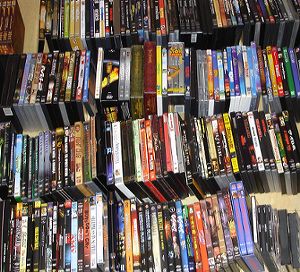
That systematic reading effort, plus writing on IRC, emails, and newsgroups with Americans, made me fluent in written English. Conversation was always the bigger challenge. Since the VHS days I never rented a single dubbed film and always avoided movies on broadcast TV. Through the whole VHS to DVD transition I always rented subtitled films, doing my best to follow subtitles and dialogue at once. It was hard at first, but when DVDs arrived I started watching films with both audio and subtitles in English.
After a few years and literally hundreds of films, I finally got to the point of turning off the subtitles. It became routine: when I watch with other people I ignore the subtitles; if it’s dubbed, I don’t watch it at all. I’m a purist about quality, and my arrogance won’t let me watch a film below the minimum quality of a DVD. Come on, we’re in the high-definition generation, HDTV.
My Free Time

Last year I started listening to audiobooks. An obvious thought crossed my mind: the time I spent in traffic, between work and home, was a huge waste. In a 24-hour day I was systematically losing more than 8% of it. Counting only the 16 to 17 hours I’m awake, almost 12%! That’s at least 2 hours a day, 5 days a week, more than the 2 hours on 2 days of any corner language course.
Thanks to the internet and BitTorrent, I downloaded dozens of books. I read all the fashionable titles, in the car: every Dan Brown, J.K. Rowling, and J.R.R. Tolkien book. I read classics like Neuromancer and 1984, and great works by Richard Dawkins, Sam Harris, and the late Carl Sagan. Easily 500 hours of audiobooks in one year, with more queued up.
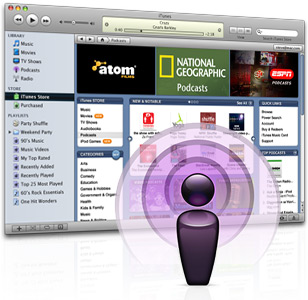
And for the past few months I can’t peel myself away from podcasts. But I don’t listen to any Brazilian ones. It has nothing to do with Brazilian xenophobia or being an American sellout, blah blah blah. First, because I find that kind of argument a total waste of time. Second, because more than idealistic anti-Americanism, it’s just an excuse to stall and not learn English. Third, because my goal is to sharpen my own English: I already practice Portuguese every day, during the other 15 hours.
Which ones do I listen to? My favorites are from TWiT.tv, led by the easygoing Leo Laporte and his guests, on shows like This WEEK in TECH, with the caustic John Dvorak, Merlin Mann, and others. There’s Steve Gibson and his Security Now!, Paul Thurrott on Windows Weekly, Merlin Mann, Alex Lindsay, and Scott Bourne on MacBreak Weekly, and Chris DiBona on FLOSS Weekly.

Speaking of John Dvorak, his controversies live on his own show, Cranky Geeks. I’ve followed his work for years, I think since the early 90s in PC Magazine. There’s also Patrick Norton on DL.tv. Cali Lewis, from GeekBrief|TV, doesn’t break any big news I don’t already know, but her charm is worth the show’s 5 minutes. Same goes for the equally charming Veronica Belmont (it’s always good to hear female voices) on C|Net’s daily show, Buzz Out Loud. Yes, interesting news, EVERY DAY!

And it’s worth mentioning: many of the podcasts I follow daily have TV-quality production. At TWiT the video podcasts are in high definition, the audio tracks have excellent mixing, the hosts have great diction, the topics are well curated, and the editing is sharp. You barely feel that amateur vibe I personally detest. Professional studios already exist, like Pixel Corps, with Alex Lindsay.

The Revision3 channel is right up there too, with the great Diggnation, Kevin Rose commenting on the front-page stories of the excellent Digg.com. Anyone well informed is practically obligated to follow Digg. And once again, people frustrate me. How can they go around talking about Web 2.0 and all that blah blah blah without a clue of what’s happening in Silicon Valley? Did nobody read last year’s Business Week piece, Valley Boys? Kevin Rose is one of the representatives of the new generation of young internet millionaires, and podcasting is one of the biggest tech media channels around.
Finally, back to reading: my routine revolves around Google Reader. As I said, I have about 90 RSS websites aggregated in Reader. During the day, 50 to 100 new stories arrive per hour. I don’t read them all: in a day I might read a dozen solid pieces. First because telling junk from useful takes experience. Second because speed reading handles it: I scan and move on. I can get through 100 stories in 15 minutes and I guarantee I don’t miss anything important.
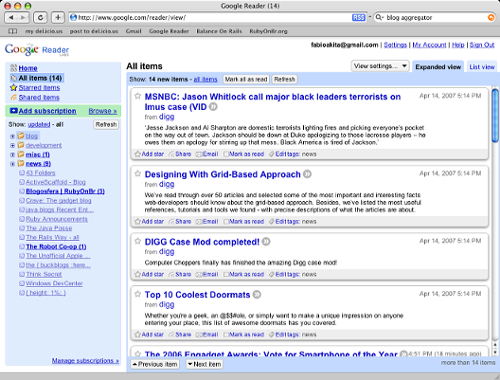
Sounds like a lot? Of course it isn’t. It takes a substantial chunk of my time, but it’s a systematic routine, as natural as brushing your teeth or taking a shower: when you skip it, you feel off the rest of the day. That’s what separates Olympic athletes from weekend players: dedication. Everyone who wants to achieve something needs to step out of the average and do things that, to the mediocre, seem like too much, impossible, unattainable.
I have one more argument. When I meet someone with more knowledge or skill in my field than I have, I just think: he’s as human as I am, so whatever he did to know more, I can do too. Everything is achievable, there’s no end, because for every ceiling there’s a higher one. It’s simply a matter of stopping saying No, more or less, maybe.

Start saying Yes and, from now on, don’t look back. If you turn around, starting again gets harder: every step backward takes two steps forward just to get back where you were.
Be arrogant, for real. A true arrogant laughs at difficulties so he can boast about the victories. Those who don’t fight have no victories and therefore can never be arrogant.
Epilogue
Before wrapping up, one more bit of help. Below are the OPML files from my Google Reader and my iTunes, the full collection of websites, blogs, and podcasts I subscribe to and consume daily. Some are old links I’ve kept for more than a decade. I hope you find them useful, and I hope everyone knows what to do with an OPML file.
If you don’t, read this link and this one.
Why so much podcast promotion? Simple: it’s the most practical way to absorb tons of high-quality informational content to practice that dreaded listening. Forget those horrible language-course cassettes. Learn from the real thing.

My next steps: keep improving my English every day and then jump to something else. I want to learn Chinese, Mandarin, the next big prerequisite of the future after English. The interesting part? The only good Chinese-learning materials I found are written in English! Virtually nothing decent about learning Chinese exists in Portuguese.
English is the starting point for everything. No use kicking and screaming, no use stalling. Most of the best materials, especially in our technology field, are written ONLY in English. Don’t fool yourselves: everything else is a pale copy of the original.
You are exactly what you make yourself